Il titanio dell'SR-71 Blackbird comprato dall'URSS: cosa è vero
Oltre il 90% dell'A-12 era in titanio e la CIA ammette che parte del metallo arrivò di nascosto dall'URSS. Cosa è noto, cosa è leggenda e perché colava JP-7.
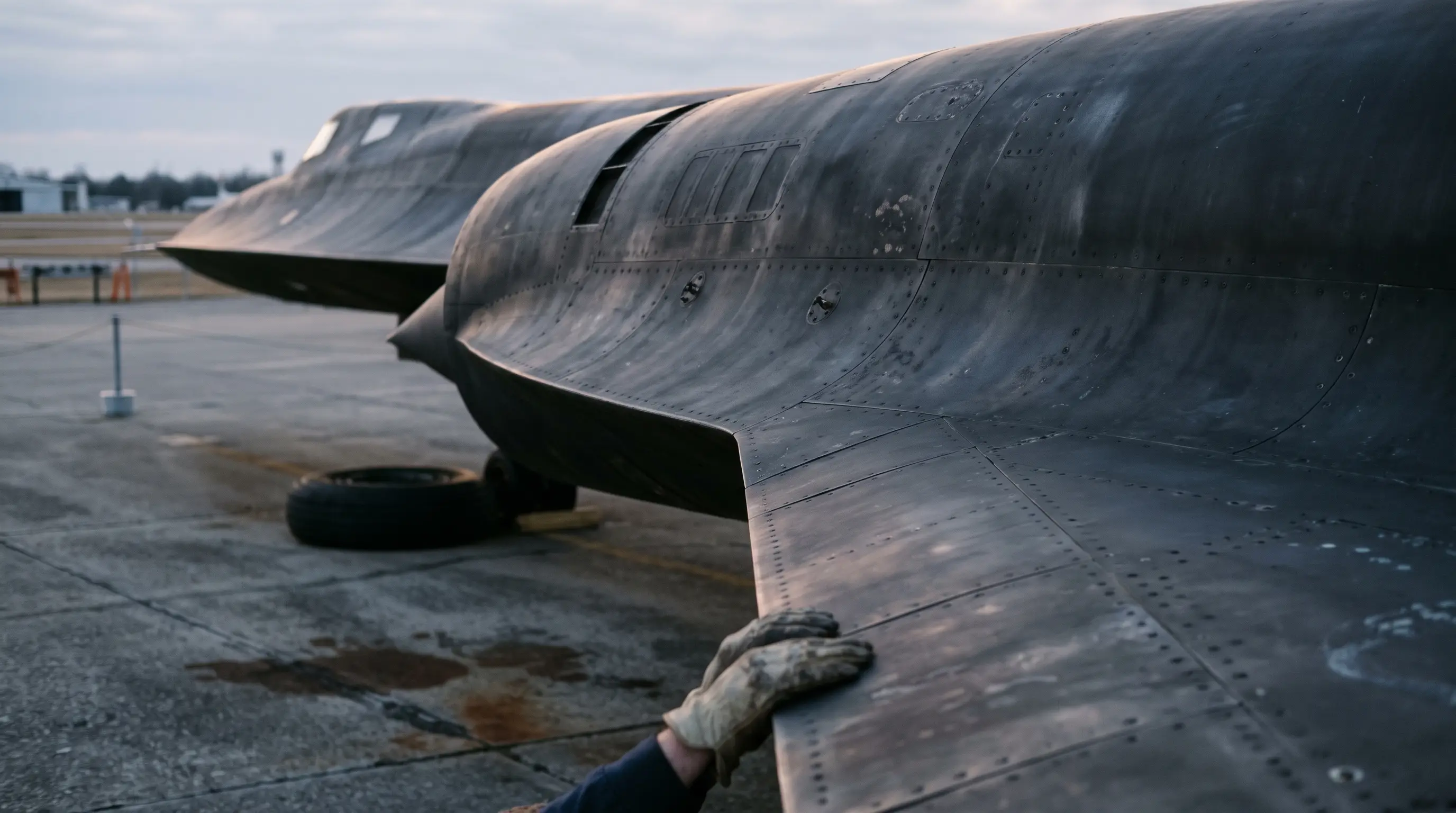
Oltre il 90% della cellula dell'A-12, da cui discende l'SR-71, era in lega di titanio.
- Cellula A-12 in titanio
- Oltre il 90%
- Quota di lega di titanio, resistente come l'inox a metà peso[3]
- Perdita accettata a terra
- 5–60 gocce/min
- Tasso di perdita ritenuto accettabile sull'A-12, secondo la fonte[22]
In questo articolo
Salta a una sezione
Perché a Mach 3 serviva il titanio
Cosa dice la CIA sull'acquisto dall'URSS
Leggenda e documenti: minerale, quote e società di comodo
| Affermazione | Stato | Cosa dicono i documenti |
|---|---|---|
| Parte del metallo base arrivò dall'URSS | Riportata dalla CIA, fonte unica | La storia della CIA la ripete citando il memoir di Rich, senza date né quantità[4] |
| Acquisto tramite terzi e società di comodo | Raccontata da un testimone | Nel memoir di Ben Rich, la stessa fonte, senza nomi[10] |
| La CIA comprava minerale | Leggenda | Il costo sta nella conversione in metallo[11] |
| Tutto il titanio era sovietico | Leggenda | La CIA scrive «some», non la totalità[4] |
Lavorare il titanio: lotti scartati, trapani rotti e cloro
- Cloro nell'acqua di Burbank: i pannelli alari saldati a punti d'estate cedevano in sei o sette settimane, quelli invernali duravano indefinitamente;[15] il rimedio fu lavarli con acqua distillata dopo il trattamento acido.[16]
- Cadmio: le chiavi cadmiate lasciavano residui sufficienti a indebolire i fissaggi,[17] e per Lockheed gli utensili in acciaio cadmiato infragilivano il titanio al contatto, così se ne costruirono di nuovi in titanio.[18]
- Inchiostro: le penne Pentel, a base di cloro, lasciavano segni di corrosione sulle lamiere e non si potevano usare per tracciare i disegni.[19]
Perché a terra perdeva carburante: dilatazione, sigillanti e JP-7
Da leggere · Aviazione e Volo
Come funziona un aereo AWACS e perché il suo radar vola alto
Domande frequenti
Perché l'SR-71 Blackbird perdeva carburante a terra?
Di che metallo era fatto l'SR-71 Blackbird?
Come fece la CIA a comprare il titanio dall'Unione Sovietica?
Il titanio dell'SR-71 Blackbird veniva davvero tutto dall'URSS?
Quanto si scaldava la cellula dell'SR-71 a Mach 3?
Fonti
24 riferimenti Mostra Nascondi
- Smithsonian National Air and Space Museum, How Things Fly (si apre in una nuova scheda)
«At speeds of Mach 3 (3 times the speed of sound) the SR- 71 Blackbird’s airframe temperature can range from 315-480 degrees Celcius (600-900 degrees Farenheit), depending on its altitude.»
- CIA, Archangel: CIA's Supersonic A-12 Reconnaissance Aircraft (leak and climb) (si apre in una nuova scheda)
«It would then rendezvous with a KC-135, top off its tanks, and immediately climb to operating altitude, which caused the metal to expand and the leaks to stop.»
- CIA, Archangel: CIA's Supersonic A-12 Reconnaissance Aircraft (airframe alloy) (si apre in una nuova scheda)
«Lockheed chose to build over 90 percent of the A-12’s airframe out of a titanium alloy. It was almost as strong as stainless steel but weighed half as much and could handle the intense heat.»
- CIA, Archangel: CIA's Supersonic A-12 Reconnaissance Aircraft (covert supply) (si apre in una nuova scheda)
«the base metal was scarce enough that some had to be obtained covertly from the country with the largest known reserves—the Soviet Union.»
- CIA, Archangel: CIA's Supersonic A-12 Reconnaissance Aircraft (skin temperatures) (si apre in una nuova scheda)
«Most of the aircraft’s skin would be subjected to temperatures between 500 and 600 degrees F., and over 1,000 degrees F. at some spots near the engines.»
- Lockheed Martin, Blackbird history (airframe alloy) (si apre in una nuova scheda)
«Titanium alloy was the only option for the airframe —providing the strength of stainless steel, a relatively light weight, and durability at the excessive temperatures.»
- OSTI, B-120VCA titanium alloy (density) (si apre in una nuova scheda)
«With its density of 0.174 pound per cubic inch, the alloy is capable of a strength-weight ratio of over 1,000,000 psi per cubic inch.»
- OSTI, B-120VCA titanium alloy (yield strength) (si apre in una nuova scheda)
«It can be hardened by an aging treatment to have yield strengths in excess of 180,000 psi.»
- Air & Space Forces Magazine, Oxcart Story (scarce titanium) (si apre in una nuova scheda)
«Titanium was scarce and very costly. Methods for milling it and controlling its quality were not fully developed.»
- Wikipedia: Lockheed A-12 (sintesi del memoir di Ben Rich) (si apre in una nuova scheda)
«using third parties and dummy companies, managed to unobtrusively purchase the base metal from one of the world's leading exporters – the Soviet Union.»
- Lockheed SR-71 Blackbird (ore vs metal) (si apre in una nuova scheda)
«While titanium ores are cheap and abundant, converting those ores into metallic titanium is laborious and expensive.»
- Air & Space Forces Magazine, Oxcart Story (rejected deliveries) (si apre in una nuova scheda)
«Some eighty percent of the early deliveries from Titanium Metals Corp. were rejected.»
- Air & Space Forces Magazine, Oxcart Story (drills) (si apre in una nuova scheda)
«Drills that worked well on aluminum soon broke. New ones had to be devised.»
- CIA, Archangel: CIA's Supersonic A-12 Reconnaissance Aircraft (drill bits) (si apre in una nuova scheda)
«By the end of the program, drill bits could make 100 holes before resharpening.»
- CIA, Archangel: CIA's Supersonic A-12 Reconnaissance Aircraft (spot welds) (si apre in una nuova scheda)
«Wing panels that were spot welded in the summer failed within six or seven weeks, but those made in the winter lasted indefinitely.»
- CIA, Archangel: CIA's Supersonic A-12 Reconnaissance Aircraft (distilled water) (si apre in una nuova scheda)
«Switching to distilled water to wash the panels after acid treatment prevented a recurrence.»
- CIA, Archangel: CIA's Supersonic A-12 Reconnaissance Aircraft (cadmium wrenches) (si apre in una nuova scheda)
«cadmium-plated wrenches left enough residue to weaken the fittings.»
- Lockheed Martin, Blackbird history (cadmium tools) (si apre in una nuova scheda)
«Conventional cadmium-plated steel tools, it was soon learned, embrittled the titanium on contact; so new tools were designed and fabricated—out of titanium.»
- CIA, Archangel: CIA's Supersonic A-12 Reconnaissance Aircraft (Pentel ink) (si apre in una nuova scheda)
«Pentel pens could not be used to draw on sheets of the metal because their chlorine-based ink left etch marks.»
- Lockheed SR-71 Blackbird (thermal expansion) (si apre in una nuova scheda)
«Proper alignment was achieved as the airframe heated up, with thermal expansion of several inches.»
- CIA, Archangel: CIA's Supersonic A-12 Reconnaissance Aircraft (sealant) (si apre in una nuova scheda)
«No sealant for the fuel tanks was ever developed that was simultaneously impervious to chemical effects caused by the fuel, and elastic enough to expand and contract as the tanks heated and cooled»
- CIA, Archangel: CIA's Supersonic A-12 Reconnaissance Aircraft (leak rate) (si apre in una nuova scheda)
«A “leak rate” of between five and 60 drops per minute, depending on the source, was considered acceptable.»
- CIA, Archangel: CIA's Supersonic A-12 Reconnaissance Aircraft (JP-7) (si apre in una nuova scheda)
«Instead, a special fuel, called JP-7, with a low vapor pressure and high flash point had to be developed; a lighted match would not ignite it.»
- CIA, Archangel: CIA's Supersonic A-12 Reconnaissance Aircraft (A-11 design) (si apre in una nuova scheda)
«It would have a top speed of Mach 3.2, a range of 3,200 miles, and an altitude of 90,000 feet»