Perché gli aerei di linea volano tra i 10.000 e i 12.000 metri
Tra 10.000 e 12.000 metri l'aria a -56,5 °C taglia i consumi dei turbofan e la resistenza: fisica della tropopausa, cabina a 8.000 piedi e coffin corner.
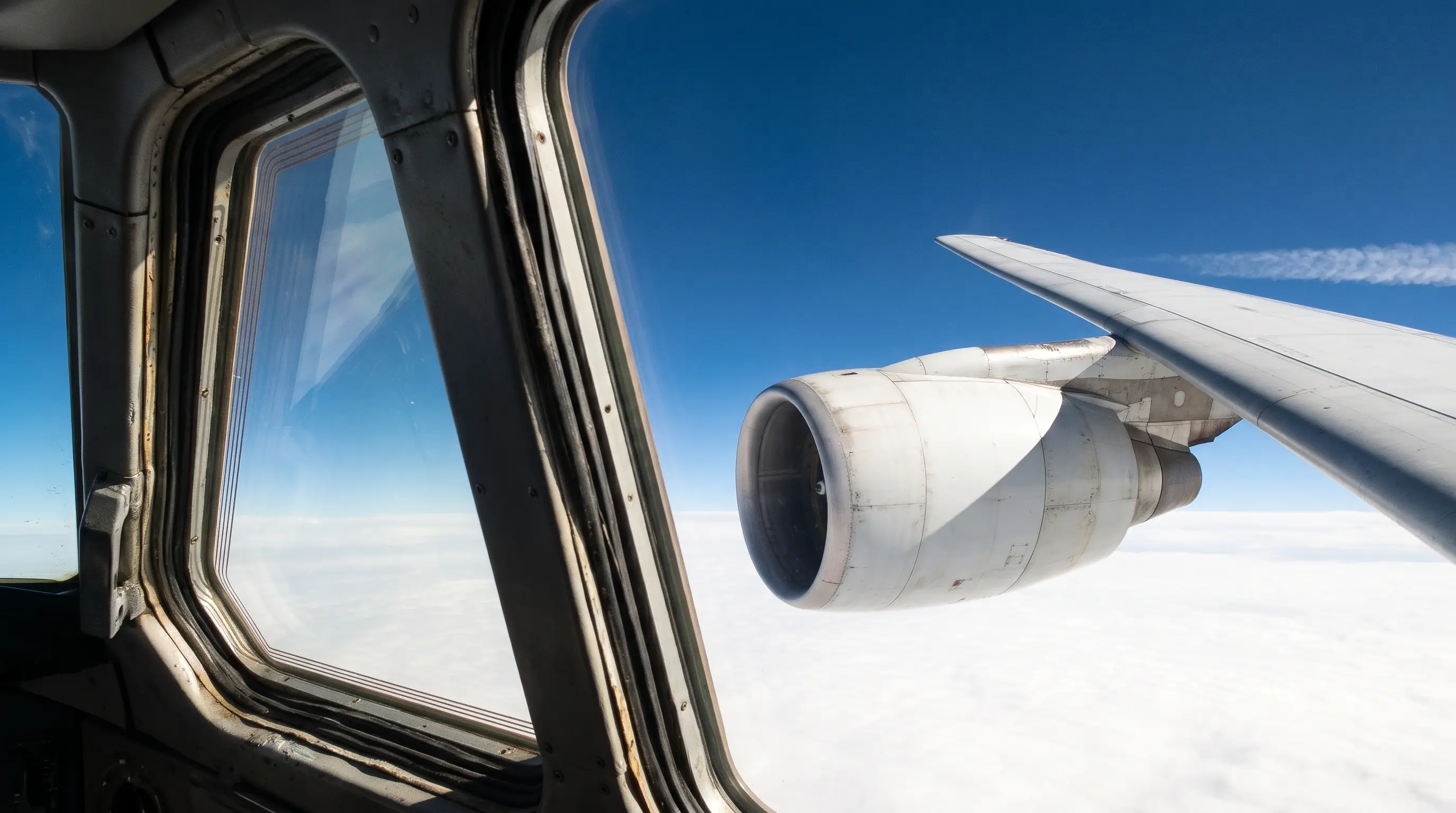
A 11.000 metri la tropopausa standard segna -56,5 °C: da lì in su l'aria smette di raffreddarsi con la quota.
- Temperatura in tropopausa
- -56,5 °C
- Soglia isoterma raggiunta a 36.090 piedi (11.000 m) nell'atmosfera standard ISA[1]
- Quota cabina massima
- 8.000 piedi
- Limite di pressione interna in esercizio normale fissato dalla norma 14 CFR § 25.841[2]
- Margine a 45.000 piedi
- 26 nodi
- Intervallo di velocità libero da buffeting a 1,0 G rispetto ai 135 nodi a FL 350[3]
In questo articolo
Salta a una sezione
La barriera della densità: resistenza parassita e velocità vera
Il confine termico a 11.000 metri: cosa cambia nella tropopausa
| Fascia atmosferica | Quota di riferimento | Temperatura (ISA) | Andamento fisico |
|---|---|---|---|
| Livello del mare (ISA) | 0 m (0 ft) | +15 °C (288 K) | Pressione di 1.013,2 mbar; velocità del suono 340 m/s[6][19] |
| Media troposfera | ~5.500 m (18.000 ft) | In calo (-1,98 °C/1.000 ft) | Densità dell'aria dimezzata al 50% del valore a livello del mare[1][7] |
| Tropopausa standard | 11.000 m (36.090 ft) | -56,5 °C | Fine del raffreddamento lineare troposferico[1][12] |
| Bassa stratosfera | 11.000–25.000 m | Costante (~217 K a 12 km) | Strato isotermo; pressione in calo esponenziale e suono a 295 m/s[13][19] |
Termodinamica dei turbofan: perché il freddo taglia i consumi
Il tetto aerodinamico: Mach critico e coffin corner
La trappola del fattore di carico a 51.000 piedi
La forbice tra stallo di bassa velocità e buffeting di Mach
Perché una virata o una raffica ad altissima quota azzerano i margini
Il limite umano e strutturale: pressurizzazione a 8.000 piedi e ipossia
- Saturazione dell'emoglobina tra 0 e 10.000 piedi: nonostante un calo del 25% della pressione atmosferica, la saturazione di ossigeno nel sangue scende solo dal 98% al 90% circa, valore tollerabile per l'organismo pur con un calo del 30% nella sensibilità visiva notturna a 10.000 piedi.[28]
- Requisiti di certificazione post-decompressione (14 CFR § 25.841): in caso di guasto probabile della pressurizzazione la cabina non deve superare i 15.000 piedi, e dopo una decompressione non estremamente improbabile nessun occupante può essere esposto a oltre 25.000 piedi per più di 2 minuti né a 40.000 piedi per alcuna durata.[26]
- Tempo di coscienza utile (TUC): sopra i 43.000 piedi una decompressione rapida riduce il tempo di capacità funzionale a soli 9–12 secondi, l'intervallo fisico impiegato dal sangue per circolare dai polmoni al cervello sommato alla minima riserva cerebrale di ossigeno.[29]
Da leggere · Aviazione e Volo
Fuel dumping: perché gli aerei scaricano carburante in volo
Domande frequenti
Perché gli aerei volano a 11.000 metri invece che a quote più basse?
Cosa succede se un aereo di linea sale troppo in alto oltre i 12.000 metri?
Perché sopra gli 11.000 metri la temperatura dell'aria smette di scendere?
Perché i motori a getto consumano meno carburante quando fuori fa molto freddo?
Qual è la pressione mantenuta dentro la cabina passeggeri in crociera?
Quanto tempo resta ai piloti per reagire in caso di depressurizzazione ad altissima quota?
Fonti
29 riferimenti Mostra Nascondi
- SKYbrary — International Standard Atmosphere (ISA) (si apre in una nuova scheda)
«Temperature falls at a rate of 2 °C per 1,000 feet until the tropopause is reached at 36,000 feet above which the temperature is assumed to be constant at -57 °C. (The precise numbers are 1.98 °C,-56.5 °C and 36,090 feet)»
- eCFR — 14 CFR § 25.841 Pressurized cabins (si apre in una nuova scheda)
«(a) Except as provided in paragraph (c) of this section, pressurized cabins and compartments to be occupied must be equipped to provide a cabin pressure altitude of not more than 8,000 feet under normal operating conditions.»
- FAA Advisory Circular AC 61-107B (si apre in una nuova scheda)
«For example, in a typical jet aircraft, the 1.0 G buffet-free margin at FL 350 is 135 kts; at FL 450, this speed is reduced to a mere 26 kts.»
- FAA Advisory Circular AC 61-107B (si apre in una nuova scheda)
«The efficiency of the jet engine at high altitudes is the primary reason for operating in the high-altitude environment. The specific fuel consumption of jet engines decreases as the outside air temperature decreases for constant revolutions per minute (rpm) and TAS.»
- FAA Advisory Circular AC 61-107B (si apre in una nuova scheda)
«Because density is always greater at sea level, the velocity at altitude given the same AOA will be greater than at sea level, although the IAS will not change. Therefore, an airplane’s TAS increases with altitude while its IAS remains constant.»
- SKYbrary — International Standard Atmosphere (ISA) (si apre in una nuova scheda)
«The ISA is based on the following values of pressure, density, and temperature at mean sea level each of which decreases with increase in height: * Pressure of 1013.2 millibar - Pressure is taken to fall at about 1 millibar per 30 feet in the lower atmosphere (up to about 5,000 feet). * Temperature of +15 °C»
- FAA Advisory Circular AC 61-107B (si apre in una nuova scheda)
«Atmospheric density in the troposphere decreases gradually with altitude, decreasing to 50 percent of its sea-level value at 18,000 ft MSL.»
- SKYbrary — Drag (si apre in una nuova scheda)
«Parasitic drag increases with the square of the airspeed, while induced drag, being a function of lift, is greatest when maximum lift is being developed, usually at low speeds.»
- SKYbrary — Induced Drag (si apre in una nuova scheda)
«The effect of this is that induced drag is relatively unimportant at high speed in the cruise and descent where it probably represents less than 10% of total drag. In the climb, it is more important representing at least 20% of total drag. At slow speeds just after take off and in the initial climb, it is of maximum importance and may produce as much as 70% of total drag.»
- SKYbrary — Induced Drag (si apre in una nuova scheda)
«Typical transport aircraft aspect ratios range between 6:1 and 10:1.»
- SKYbrary — Parasite Drag (si apre in una nuova scheda)
«Parasite drag is caused by moving a solid object through a fluid medium.»
- NASA Glenn Research Center — Earth Atmosphere Model (Metric) (si apre in una nuova scheda)
«The troposphere runs from the surface of the Earth to 11,000 meters. In the troposphere, the temperature decreases linearly and the pressure decreases exponentially.»
- NASA Glenn Research Center — Earth Atmosphere Model (Metric) (si apre in una nuova scheda)
«The lower stratosphere runs from 11,000 meters to 25,000 meters. In the lower stratosphere the temperature is constant and the pressure decreases exponentially.»
- SKYbrary — Tropopause (si apre in una nuova scheda)
«the "first tropopause" is conventionally defined as the lowest level at which the lapse rate decreases to 2°C/km or less, provided also that the average lapse rate between this level and all higher levels within 2 km does not exceed 2°C/km.»
- SKYbrary — Tropopause (si apre in una nuova scheda)
«The tropopause occurs at approximately 20,000 feet over the poles and at approximately 60,000 feet above the equator.»
- SKYbrary — Tropopause (si apre in una nuova scheda)
«The location of the tropopause is of interest to flight crew because it indicates the altitude at which temperature becomes constant with increasing altitude, which is an import factor in performance and fuel calculations.»
- NASA Glenn Research Center — Brayton Thermodynamic Cycle (si apre in una nuova scheda)
«On this page we discuss the Brayton Thermodynamic Cycle which is used in all gas turbine engines.»
- NASA Glenn Research Center — Brayton Thermodynamic Cycle (si apre in una nuova scheda)
«The area under the T-s diagram is proportional to the useful work and thrust generated by the engine.»
- MIT Unified Engineering — Propulsion Notes (Gas Turbine Cycle) (si apre in una nuova scheda)
«Table 11.1: Turbojet Mission Parameters Mach number Altitude Ambient Temp. Speed of sound 0 Sea level 288 K 340 m/s 0.85 12 km 217 K 295 m/s»
- MIT Unified Engineering — Propulsion Notes (Gas Turbine Cycle) (si apre in una nuova scheda)
«There is a strong sensitivity to the component efficiencies. For example, for , the cycle efficiency is roughly two-thirds of the ideal value.»
- SKYbrary — Mach Number (si apre in una nuova scheda)
«In cruise, most jet-powered transport category aircraft set speed by Mach number. For example, a captain might set a cruise speed of 0.82 Mach.»
- SKYbrary — Critical Mach Number (si apre in una nuova scheda)
«(M cr or M crit) of an aircraft is the lowest Mach number at which the airflow over any part of the aircraft reaches the speed of sound.»
- SKYbrary — Coffin Corner (si apre in una nuova scheda)
«As an aircraft climbs towards the altitude that defines its coffin corner, the margin between stall speed and critical Mach number becomes smaller and smaller until the Flight Envelope boundaries intersect.»
- SKYbrary — Coffin Corner (si apre in una nuova scheda)
«In the most critical case, simply turning the aircraft could result in exceeding both limits simultaneously as, in a turn, the inside wing slows down whereas the outside wing increases speed.»
- FAA Advisory Circular AC 61-107B (si apre in una nuova scheda)
«A typical turbojet airplane flying at 51,000 ft MSL altitude at 1.0 G may encounter Mach buffet slightly above the airplane’s MMO (0.82 Mach) and low-speed buffet at 0.60 Mach. However, only 1.4 G (an increase of only 0.4 G) may bring on buffet at the optimum speed of 0.73 Mach and any change in airspeed, bank angle, or gust loading may reduce this straight and level flight 1.4 G protection to no protection.»
- eCFR — 14 CFR § 25.841 Pressurized cabins (si apre in una nuova scheda)
«(2) The airplane must be designed so that occupants will not be exposed to a cabin pressure altitude that exceeds the following after decompression from any failure condition not shown to be extremely improbable: (i) Twenty-five thousand (25,000) feet for more than 2 minutes; or (ii) Forty thousand (40,000) feet for any duration.»
- SKYbrary — Aircraft Pressurisation Systems (si apre in una nuova scheda)
«If the aircraft continues to climb once the maximum differential pressure is reached, the differential pressure will be maintained while the cabin altitude climbs. The maximum cruise altitude will be limited by the need to keep the cabin altitude at or below 8,000 ft.»
- SKYbrary — Hypoxia (si apre in una nuova scheda)
«Between the surface and 10,000 feet altitude, even though air pressure decreases by 25%, the saturation of haemoglobin with oxygen only declines from about 98% to 90% which makes little difference to most human functions; the exception to this is a gradual onset of significant deterioration in night vision sensitivity, which has been found to reduce by 30% by 10,000 feet altitude.»
- FAA Advisory Circular AC 61-107B (si apre in una nuova scheda)
«Above 43,000 ft, the TUC is reduced to the time it takes for the blood to circulate from the lung to the brain, plus any reserve oxygen stored in the brain. This is approximately 9–12 s from the start of a rapid decompression to the loss of functional capability.»