Fuel dumping: perché gli aerei scaricano carburante in volo
Perché alcuni aerei scaricano carburante in volo: limite MLW contro MTOW, ugelli alari, quote di atomizzazione, ruolo dell'ATC e il caso Delta 89 del 2020.
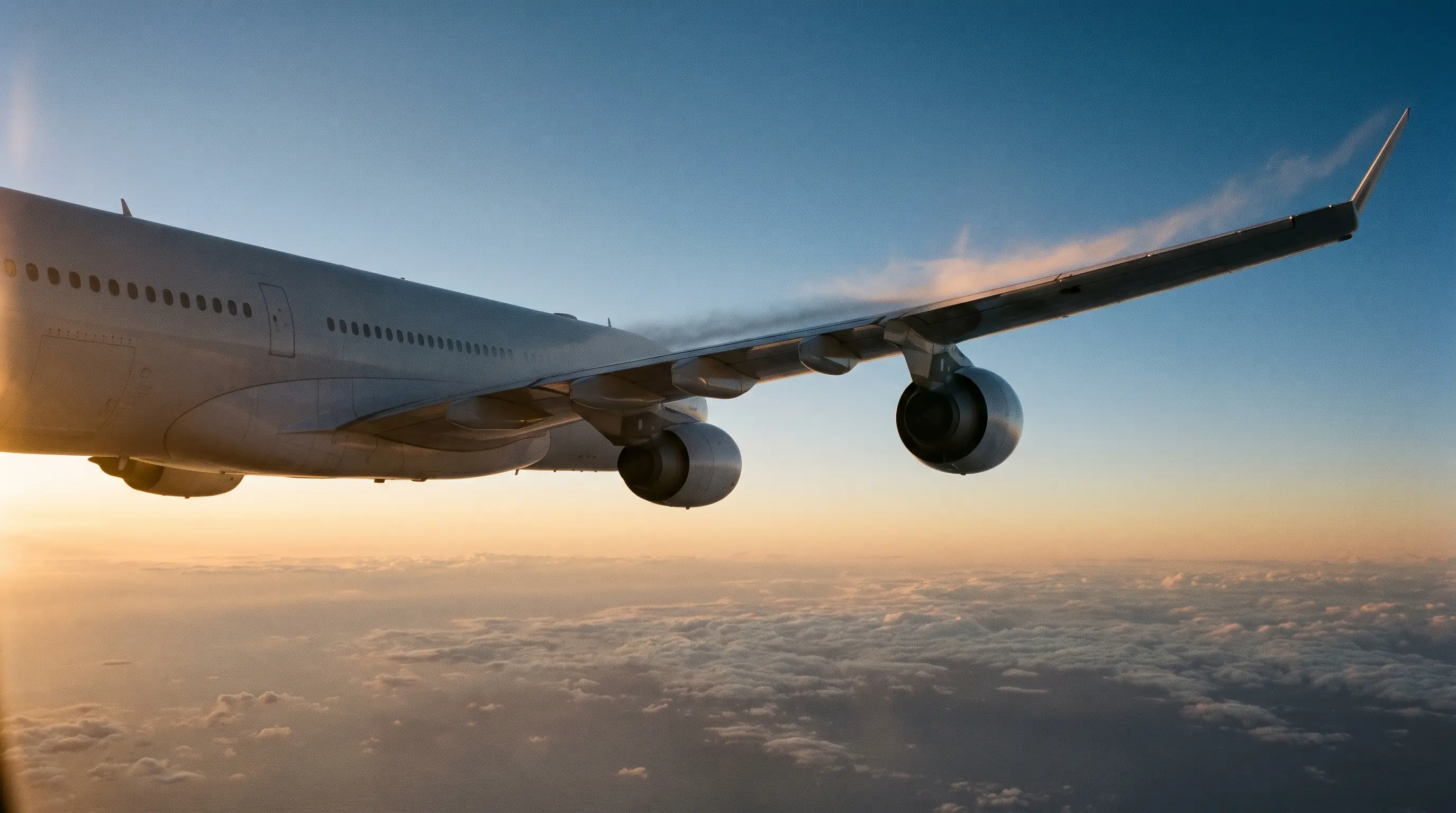
Per la norma 14 CFR 25.1001 l'impianto di scarico deve liberare in 15 minuti carburante sufficiente a tornare ai requisiti di salita.
- Tempo di scarico richiesto
- 15 min
- Carburante sufficiente per tornare ai requisiti di salita, 14 CFR 25.1001[2]
- Quota di vaporizzazione
- 5.000-6.000 ft
- Sopra questa fascia, per studi USAF citati da Boeing, il carburante vaporizza[3]
- Precipitato a 20 °C al suolo
- 4%
- Modello BMU, scarico a 5.000 ft e ipotesi sfavorevoli; con -10 °C sale al 59%[4]
In questo articolo
Salta a una sezione
Perché atterrare tollera meno peso che decollare
Ugelli alari e portate: come si scarica davvero
Dove finisce il carburante: atomizzazione ed evaporazione in quota
Cosa fa l'ATC mentre l'aereo scarica
Da leggere · Aviazione e Volo
Perché gli aerei di linea volano tra i 10.000 e i 12.000 metri
Atterrare in sovrappeso e il caso Delta 89
Frenata massima in sovrappeso
I rischi di un aereo troppo pesante
Delta 89 a Los Angeles, 2020
Domande frequenti
Perché gli aerei scaricano carburante prima di atterrare in emergenza?
Lo scarico di carburante di un aereo (fuel dumping) in emergenza è legale e chi lo autorizza?
Il carburante scaricato arriva a terra?
Tutti gli aerei possono scaricare carburante?
Quanto carburante scarica un aereo e in quanto tempo?
Cosa succede se un aereo atterra in sovrappeso?
Fonti
52 riferimenti Mostra Nascondi
- Popular Science - Airplane fuel dumping and landing weight (si apre in una nuova scheda)
«The max landing weight exists mostly because of structural concerns, such as how strong the landing gear is and the forces on the wings as the plane touches down, Crossley explains.»
- 14 CFR 25.1001 - Fuel jettisoning system (si apre in una nuova scheda)
«If a fuel jettisoning system is required it must be capable of jettisoning enough fuel within 15 minutes»
- PRISM research brief - Fuel jettison (si apre in una nuova scheda)
«These studies have shown that, in general, fuel jettisoned above 5,000 to 6,000 feet will completely vaporize before reaching the ground.»
- BMU - Kerosin Fuel Dumping (si apre in una nuova scheda)
«Gemäß den Modellberechnungen treffen bei einer Lufttemperatur am Erdboden von 20 °C ca. 4 % des Präzipitats mit einer maximalen Konzentration von 0,006 g/m² auf der Erdoberfläche auf.»
- 14 CFR 25.473 - Landing load conditions and assumptions (si apre in una nuova scheda)
«With a limit descent velocity of 6 fps at the design take-off weight (the maximum weight for landing conditions at a reduced descent velocity).»
- 14 CFR 25.473 - Landing load conditions and assumptions (si apre in una nuova scheda)
«With a limit descent velocity of 10 fps at the design landing weight (the maximum weight for landing conditions at maximum descent velocity); and»
- 14 CFR 25.119 - Landing climb: All-engines-operating (si apre in una nuova scheda)
«In the landing configuration, the steady gradient of climb may not be less than 3.2 percent»
- 14 CFR 25.121 - Climb: One-engine-inoperative (si apre in una nuova scheda)
«The steady gradient of climb may not be less than 2.1 percent for two-engine airplanes, 2.4 percent for three-engine airplanes, and 2.7 percent for four-engine airplanes»
- SmartCockpit - Overweight landing: what to consider (si apre in una nuova scheda)
«An overweight landing is defined as a landing made at a gross weight in excess of the maximum design (i.e., structural) landing weight for a particular model.»
- Fuel fraction (si apre in una nuova scheda)
«Airliners have a fuel fraction of less than half their takeoff weight, between 26% for medium-haul to 45% for long-haul.»
- Fuel dumping (si apre in una nuova scheda)
«if the ratio between an aircraft's maximum structural takeoff weight and its maximum structural landing weight was greater than 1.05, the aircraft had to have a fuel-dump system installed.»
- 14 CFR 25.1001 - Fuel jettisoning system (si apre in una nuova scheda)
«A fuel jettisoning system must be installed on each airplane unless it is shown that the airplane meets the climb requirements of §§ 25.119 and 25.121(d) at maximum takeoff weight»
- EASA CS-25 - Fuel jettisoning system (si apre in una nuova scheda)
«A fuel jettisoning system must be installed on each aeroplane unless it is shown that the aeroplane meets the climb requirements of CS 25.119 and 25.121(d) at maximum take-off weight»
- EASA CS-25 - Fuel jettisoning system (si apre in una nuova scheda)
«Means must be provided to prevent jettisoning the fuel in the tanks used for take-off and landing below the level allowing climb from sea level to 3048 m (10 000 ft) and thereafter allowing 45 minutes cruise at a speed for maximum range.»
- Popular Science - Airplane fuel dumping and landing weight (si apre in una nuova scheda)
«But big ones like the 747, 787, or A380 can release it from their wingtips.»
- Fuel dumping (si apre in una nuova scheda)
«A Boeing 757 has no fuel-dump capability as its maximum landing weight is similar to the maximum take-off weight.»
- Boeing 767 fuel dumping briefing (si apre in una nuova scheda)
«Discharge nozzles inboard of each outboard aileron - Only operational for the CENTER tank»
- Boeing 767 fuel dumping briefing (si apre in una nuova scheda)
«1200 kg/min. for 2 nozzles (with Center fuel pumps ON) / 600 kg/min. without Center fuel pumps»
- Fuel dumping (si apre in una nuova scheda)
«pilots either quote dump rates ranging within 1–2 tons per minute»
- Boeing 767 fuel dumping briefing (si apre in una nuova scheda)
«Electrical load shedding will occur during fuel jettison»
- 14 CFR 25.1001 - Fuel jettisoning system (si apre in una nuova scheda)
«The fuel discharges clear of any part of the airplane;»
- PRISM research brief - Fuel jettison (si apre in una nuova scheda)
«There is no restriction on fuel jettison during an in-flight fire, whether inside or outside the airplane.»
- BMU - Kerosin Fuel Dumping (si apre in una nuova scheda)
«During fuel dumping, the kerosene is spread at high altitudes into a fine droplet mist via high-performance nozzles.»
- PRISM research brief - Fuel jettison (si apre in una nuova scheda)
«As fuel is jettisoned, it is rapidly broken up into small droplets, which then vaporize.»
- PRISM research brief - Fuel jettison (si apre in una nuova scheda)
«Fuel jettison studies have indicated that the most significant variables related to fuel vaporization are fuel type and outside air temperature.»
- FAA update on Delta Flight 89 fuel jettison (si apre in una nuova scheda)
«Delta trains its crews that 4,000’ was recommended as the minimum»
- AFIT thesis on JP-8 fuel jettison (si apre in una nuova scheda)
«We conclude that the recommended jettison release altitude for large body aircraft of 6000 meters is adequate.»
- PRISM research brief - Fuel jettison (si apre in una nuova scheda)
«Even though fuel is vaporized, it is still suspended in the atmosphere.»
- BMU - Kerosin Fuel Dumping (si apre in una nuova scheda)
«Analog können bei einer Lufttemperatur von -10 °C am Erdboden 59 % des Präzipitats mit einer maximalen Konzentration von ca. 0,16 g/m² den Erdboden erreichen.»
- PRISM research brief - Fuel jettison (si apre in una nuova scheda)
«Should it become necessary to dump fuel, the pilot should immediately advise ATC.»
- Popular Science - Airplane fuel dumping and landing weight (si apre in una nuova scheda)
«The FAA notes that pilots don’t technically need to get the administration’s permission to dump their fuel, but they should notify it when they are doing so if they can.»
- FAA JO 7110.65 - Fuel dumping (si apre in una nuova scheda)
«If an aircraft is dumping fuel in IFR conditions, assign an altitude at least 2,000 feet above the highest obstacle within 5 miles of the route or pattern being flown.»
- FAA JO 7110.65 - Fuel dumping (si apre in una nuova scheda)
«Facilities concerned must broadcast an advisory on appropriate radio frequencies at 3-minute intervals until the dumping stops.»
- FAA JO 7110.65 - Fuel dumping (si apre in una nuova scheda)
«Except when it is dumping fuel for emergency reasons, an aircraft in either VFR or IFR conditions may be requested to fly a different route.»
- CNN - Delta jet fuel dumping questions (si apre in una nuova scheda)
«These procedures call for fuel to be dumped over designated unpopulated areas, typically at higher altitudes so the fuel atomizes and disperses before it reaches the ground»
- Popular Science - Airplane fuel dumping and landing weight (si apre in una nuova scheda)
«over the past three years, they know of 47 times that an American airline has dumped fuel somewhere globally»
- Fuel dumping (si apre in una nuova scheda)
«Modern aircraft are designed with possible overweight landings in mind, but this is not done except in cases of emergency, and various maintenance inspections are required afterwards.»
- Boeing 767 fuel dumping briefing (si apre in una nuova scheda)
«Although overweight landings do not necessarily have to cause structural damage if a minimum rate of descent is achieved on landing»
- FAA update on Delta Flight 89 fuel jettison (si apre in una nuova scheda)
«Landing at a weight other than what is known and planned for could result in a tail strike, aircraft damage, runway overrun, or loss of control during landing.»
- FAA update on Delta Flight 89 fuel jettison (si apre in una nuova scheda)
«Ship 7004 Maximum Takeoff Weight 656,000 lbs.»
- FAA update on Delta Flight 89 fuel jettison (si apre in una nuova scheda)
«Landed approximately 65,000 lbs over maximum landing weight»
- FAA update on Delta Flight 89 fuel jettison (si apre in una nuova scheda)
«After departure from LAX the crew experienced a compressor stall which lead to an engine failure at around 8,000’ and a subsequent return to LAX.»
- FAA update on Delta Flight 89 fuel jettison (si apre in una nuova scheda)
«Engine was operated at idle for the rest of the flight»
- FAA update on Delta Flight 89 fuel jettison (si apre in una nuova scheda)
«Boeing B-777 Quick Reference Handbook (QRH), “ENG LIM / SURGE / STALL” procedure does not require fuel dumping»
- FAA update on Delta Flight 89 fuel jettison (si apre in una nuova scheda)
«Maximum reverse thrust on only one engine, increases aircraft yaw and decreases controllability.»
- FAA update on Delta Flight 89 fuel jettison (si apre in una nuova scheda)
«During the return to LAX, the flight overflew a populated area and descended to an altitude that did not allow for the fuel to fully atomize.»
- FAA update on Delta Flight 89 fuel jettison (si apre in una nuova scheda)
«Interviews revealed that the crew was unaware that their fuel was not atomizing prior to reaching the ground»
- CNN - Delta jet fuel dumping questions (si apre in una nuova scheda)
«A review of yesterday’s air traffic control communications shows the Delta Flight 89 crew did not tell air traffic control that they needed to dump fuel,»
- FAA update on Delta Flight 89 fuel jettison (si apre in una nuova scheda)
«Changing course in order to fly over water would have required the aircraft to cross over high terrain a second time, on only one engine»
- Popular Science - Airplane fuel dumping and landing weight (si apre in una nuova scheda)
«The Los Angeles Times reported that 60 people—including at least 20 children—received treatment after the incident.»
- One Mile at a Time - Delta pays for fuel dumping incident (si apre in una nuova scheda)
«Delta has agreed to settle and pay $78.75 million.»
- FAA update on Delta Flight 89 fuel jettison (si apre in una nuova scheda)
«Maximum braking during an overweight landing increases the risk of brake failure and fire.»