La fisica delle scie di condensa: perché gli aerei le lasciano
Come si formano le scie di condensa degli aerei: soglia dei −40 °C, fuliggine, regioni sovrasature, forzante dei cirri e cosa cambiano rotte e carburanti.
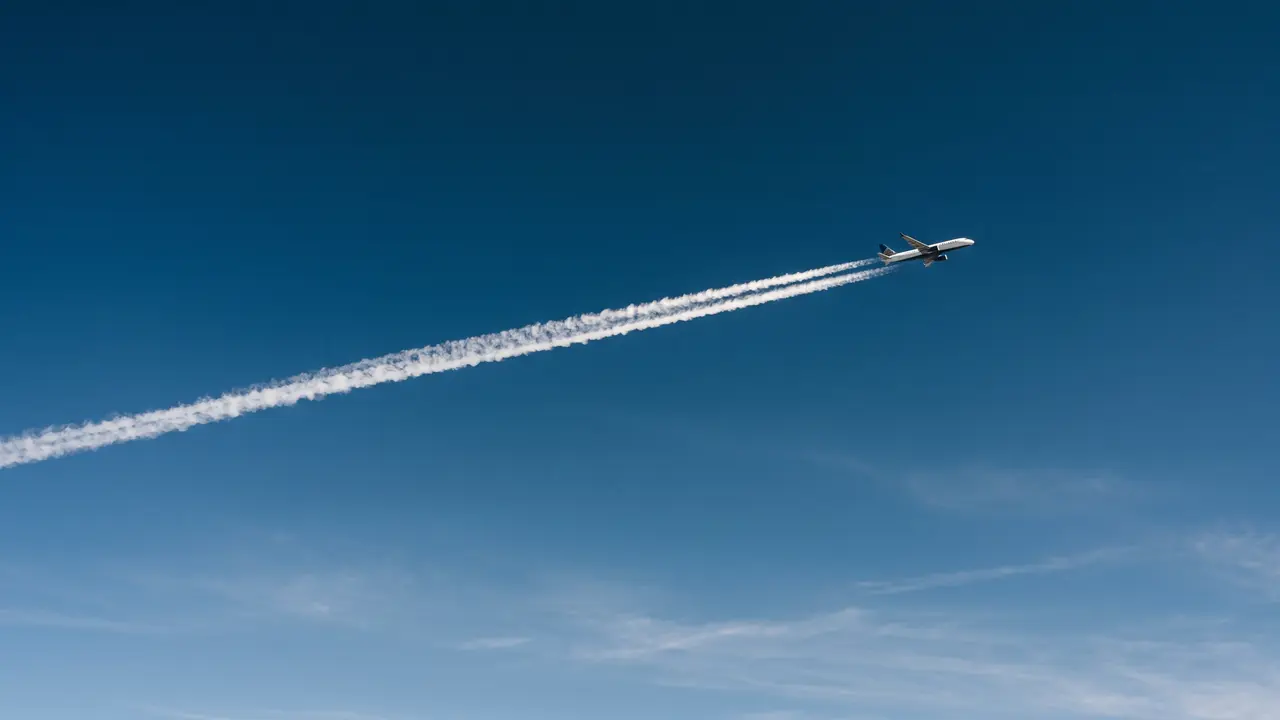
Con umidità relativa rispetto al ghiaccio di almeno il 100 % una scia di condensa è persistente.
In questo articolo
Salta a una sezione
Il criterio di Schmidt-Appleman in breve
Motore, fuliggine e cristalli di ghiaccio
Regioni sovrasature: perché alcune scie durano ore
24 %
Quanto scaldano: il forzante dei cirri da scia
Evitare le scie: pochi voli, molto forzante
Carburanti sostenibili: i dati di un solo volo
Da leggere · Aviazione e Volo
Fuel dumping: perché gli aerei scaricano carburante in volo
Domande frequenti
Scie di condensa degli aerei: come si formano?
A che temperatura si formano le scie di condensa?
Perché alcune scie durano ore e altre no?
Il carburante sostenibile riduce le scie di condensa?
Le scie di condensa sono chemtrail?
Fonti
51 riferimenti Mostra Nascondi
- Hofer e Gierens, Atmospheric Chemistry and Physics (si apre in una nuova scheda)
«Contrail formation is possible once the ambient air is sufficiently moist and cold (below −40 °C).»
- Hofer e Gierens, Atmospheric Chemistry and Physics (si apre in una nuova scheda)
«Contrails are persistent when the ambient relative humidity with respect to ice is at least 100 %.»
- Hofer e Gierens, Atmospheric Chemistry and Physics (si apre in una nuova scheda)
«Contrails can last for many hours in the sky if they form in ice supersaturated regions (ISSRs).»
- Lee et al., stima dell'ERF dell'aviazione nel 2018 (White Rose) (si apre in una nuova scheda)
«Contrail cirrus, consisting of linear contrails and the cirrus cloudiness arising from them, yields the largest positive net (warming) ERF term followed by CO2 and NOx emissions.»
- NASA Technical Memorandum sulle scie di condensa (si apre in una nuova scheda)
«Aircraft contrail formation conditions have been relatively well understood, which is an atmospheric thermodynamics process based on the Schmidt-Appleman criterion»
- Schumann, Meteorologische Zeitschrift (si apre in una nuova scheda)
«The thermodynamical foundation of the Appleman threshold criterion for contrail formation has been first described by Schmidt in 1940.»
- DLR, Contrail formation and persistence conditions for alternative fuels (si apre in una nuova scheda)
«provided a formula for the maximum temperature, Tmax, at which contrails can form»
- NASA Technical Memorandum sulle scie di condensa (si apre in una nuova scheda)
«Contrails are formed in humid ambient air, typically with relative humidity with respect to water greater than 50%.»
- NASA Technical Memorandum sulle scie di condensa (si apre in una nuova scheda)
«Contrail formation requires less water vapor in the ambient air at higher altitudes (but below the tropopause)»
- Schumann, Meteorologische Zeitschrift (si apre in una nuova scheda)
«the conversion of part of the combustion heat into kinetic energy of the motions in the wake of the aircraft causing higher threshold temperatures for contrail formation than without this conversion»
- DLR, Contrail formation and persistence conditions for alternative fuels (si apre in una nuova scheda)
«burning one kg of kerosene yields 1.24 kg of water vapour»
- EASA, nota tecnica sugli effetti non-CO2 dell'aviazione (si apre in una nuova scheda)
«Contrail ice crystals form when conditions in the exhaust plume allow water vapour to condense onto particles emitted by the aircraft engine»
- Atmospheric Chemistry and Physics, simulazione della formazione dei cristalli (si apre in una nuova scheda)
«Our simulation results suggest that ice particles are mainly formed by water condensation on emitted soot particles.»
- Atmospheric Chemistry and Physics, simulazione della formazione dei cristalli (si apre in una nuova scheda)
«The initial properties of soot emissions play the most critical role»
- NASA Technical Memorandum sulle scie di condensa (si apre in una nuova scheda)
«freezing at a lower supersaturation value due to the addition of engine-emitted cloud forming particles (soot) or cloud condensation nuclei»
- DLR, Contrail formation and persistence conditions for alternative fuels (si apre in una nuova scheda)
«With current soot levels in the fuel, the number of ice crystals is reduced in proportion to the reduction of the soot number emission, up to a reduction factor of about 100.»
- DLR, Contrail formation and persistence conditions for alternative fuels (si apre in una nuova scheda)
«we assume η = 0.35, which corresponds to the over-all propulsion efficiency of modern aircraft»
- NASA Technical Memorandum sulle scie di condensa (si apre in una nuova scheda)
«the critical temperature increases by a rate about 1.4 Kevin per 10% increment in 𝜂 enabling the potential to form contrails at lower altitudes»
- Schumann, Meteorologische Zeitschrift (si apre in una nuova scheda)
«If the aircraft would burn liquid hydrogen (liquid methane) instead of kerosene fuel, contrails would appear at typically 10 K (4.5 K) higher ambient temperatures»
- Hofer e Gierens, Atmospheric Chemistry and Physics (si apre in una nuova scheda)
«Ice supersaturation is an immaterial feature, which does not generally move with the wind.»
- Teoh et al., Atmospheric Chemistry and Physics (si apre in una nuova scheda)
«contrails do not sublimate immediately when the RHi is less than 100 %, as the ice crystal sublimation rate depends on the background RHi»
- Teoh et al., Atmospheric Chemistry and Physics (si apre in una nuova scheda)
«Over time, contrails formed in ice supersaturated regions (ISSRs) can persist, spread, and mix with natural cirrus and transition into contrail cirrus clusters with observed lifetimes of up to 19 h (Haywood et al., 2009).»
- Teoh et al., Atmospheric Chemistry and Physics (si apre in una nuova scheda)
«The contrail spreading rate and coverage area is predominantly determined by horizontal wind components, wind shear, and ice»
- EASA, nota tecnica sugli effetti non-CO2 dell'aviazione (si apre in una nuova scheda)
«thin, short-lived contrails are produced in the largest numbers, with long-lived contrails and contrails with large optical depth being rarer»
- Atmospheric Chemistry and Physics, sovrasaturazione rispetto al ghiaccio da satellite (si apre in una nuova scheda)
«They suffer from coarse vertical resolution, especially in the upper troposphere and therefore are unable to detect shallow ice supersaturated layers.»
- Teoh et al., Atmospheric Chemistry and Physics (si apre in una nuova scheda)
«of which 24 % of flights and 5 % of the annual distance flown formed persistent contrails»
- Lee et al., stima dell'ERF dell'aviazione nel 2018 (White Rose) (si apre in una nuova scheda)
«For 2018 the net aviation ERF is +100.9 mW (mW) m−2»
- Lee et al., stima dell'ERF dell'aviazione nel 2018 (White Rose) (si apre in una nuova scheda)
«with major contributions from contrail cirrus (57.4 mW m−2), CO2 (34.3 mW m−2), and NOx (17.5 mW m−2)»
- Lee et al., stima dell'ERF dell'aviazione nel 2018 (White Rose) (si apre in una nuova scheda)
«Non-CO2 terms sum to yield a net positive (warming) ERF that accounts for more than half (66%) of the aviation net ERF in 2018.»
- Lee et al., stima dell'ERF dell'aviazione nel 2018 (White Rose) (si apre in una nuova scheda)
«The mean contrail cirrus ERF/RF ratio of 0.42 indicates that contrail cirrus is less effective in surface warming than other terms.»
- Teoh et al., Atmospheric Chemistry and Physics (si apre in una nuova scheda)
«Our 2019 global annual mean contrail net RF (62.1 mW m−2) is 44 % lower than current best estimates for 2018 (111 [33, 189] mW m−2, 95 % confidence interval).»
- Teoh et al., Atmospheric Chemistry and Physics (si apre in una nuova scheda)
«Lee et al. (2021) compiled results from these studies and used the growth in annual flight distance flown to extrapolate the 2006 global annual mean contrail net RF to 2018»
- Teoh et al., Atmospheric Chemistry and Physics (si apre in una nuova scheda)
«COVID-19 caused significant reductions in the global annual mean contrail cirrus net RF in 2020 (27.3 mW m−2) and 2021 (31.7 mW m−2) when compared to 2019 (62.1 mW m−2).»
- EASA, nota tecnica sugli effetti non-CO2 dell'aviazione (si apre in una nuova scheda)
«Contrails are warming during the night, since there is no sunlight to reflect.»
- EASA, nota tecnica sugli effetti non-CO2 dell'aviazione (si apre in una nuova scheda)
«the contrail cirrus contribution to warming of global average surface temperature has a 90% chance of being between 0.01 to 0.05°C, with a best estimate of 0.02°C»
- EASA, nota tecnica sugli effetti non-CO2 dell'aviazione (si apre in una nuova scheda)
«A large fraction of total contrail radiative forcing is caused by a minority of flights.»
- Teoh et al., Atmospheric Chemistry and Physics (Nord Atlantico) (si apre in una nuova scheda)
«On average (from 2016 to 2020), around 12 % of all flights in this region accounted for 80 % of the annual EFcontrail»
- Teoh et al., Atmospheric Chemistry and Physics (Nord Atlantico) (si apre in una nuova scheda)
«An earlier study focusing on the Japanese airspace (Teoh et al., 2020b) found that 2 % of all flights are responsible for 80 % of the contrail energy forcing»
- EASA, nota tecnica sugli effetti non-CO2 dell'aviazione (si apre in una nuova scheda)
«It remains difficult to predict which flight belongs to the minority that exerts the strongest climate effect.»
- EASA, nota tecnica sugli effetti non-CO2 dell'aviazione (si apre in una nuova scheda)
«A recent study suggests that ice supersaturated regions can be forecast 6 to 18 hours in advance with 80% of observed ISSRs being correctly forecast for a selection of North Atlantic and European flights»
- Teoh et al., Aerospace (DLR), simulazione sullo spazio aereo giapponese (si apre in una nuova scheda)
«reroutes 15.3% of flights to avoid long-lived warming contrails, while allowing for cooling contrails, reduces the contrail energy forcing (EF_contrail) by 105% [91.8, 125%] with a total fuel penalty of 0.70% [0.66, 0.73%]»
- Teoh et al., Aerospace (DLR), simulazione sullo spazio aereo giapponese (si apre in una nuova scheda)
«these strategies produce a suboptimal outcome because most contrails have a short lifetime, and some have a cooling effect»
- MIT DSpace, tesi sul re-routing verticale (si apre in una nuova scheda)
«nearly 100% of contrail length can be avoided using vertical re-routing exclusively»
- Atmospheric Chemistry and Physics, misure con HEFA-SPK (si apre in una nuova scheda)
«Figure 2a shows a reduction in the median AEI for 100 % HEFA-SPK compared to Jet A-1 of 56 %.»
- Atmospheric Chemistry and Physics, misure con HEFA-SPK (si apre in una nuova scheda)
«the median nvPM EIs are reduced by 35 %»
- Atmospheric Chemistry and Physics, misure con HEFA-SPK (si apre in una nuova scheda)
«Global climate model simulations for the 2018 fleet conservatively estimate a 26 % decrease in contrail radiative forcing»
- Atmospheric Chemistry and Physics, misure con HEFA-SPK (si apre in una nuova scheda)
«the flight on 16 April 2021 stands out as having produced contrail data under ice-supersaturated conditions in a narrow range of atmospheric ambient and engine conditions»
- Atmospheric Chemistry and Physics, simulazione della formazione dei cristalli (si apre in una nuova scheda)
«are the most uncertain components of the aviation impacts on climate change»
- Lee et al., stima dell'ERF dell'aviazione nel 2018 (White Rose) (si apre in una nuova scheda)
«non-CO2 forcing terms contribute about 8 times more than CO2 to the uncertainty in the aviation net ERF in 2018.»
- Wikipedia, Chemtrail conspiracy theory (si apre in una nuova scheda)
«There is no evidence that purported chemtrails differ from normal water-based contrails routinely left by high-flying aircraft under certain atmospheric conditions.»
- Wikipedia, Chemtrail conspiracy theory (riporta Shearer et al., 2016) (si apre in una nuova scheda)
«A 2016 survey of 77 atmospheric scientists concluded that "76 out of 77 (98.7%) of scientists that took part in this study said they had not encountered evidence»