Dai pollici ai metri: gli errori di unità che abbattono le sonde
Dal ponte di Laufenburg sfasato di 54 cm alla sonda Mars Climate Orbiter persa per un fattore 4,45: come nascono gli errori di unità di misura in ingegneria.
Il Mars Climate Orbiter è entrato nell'atmosfera di Marte a 57 km di quota nel 1999, per uno scambio tra libbre-forza e newton.
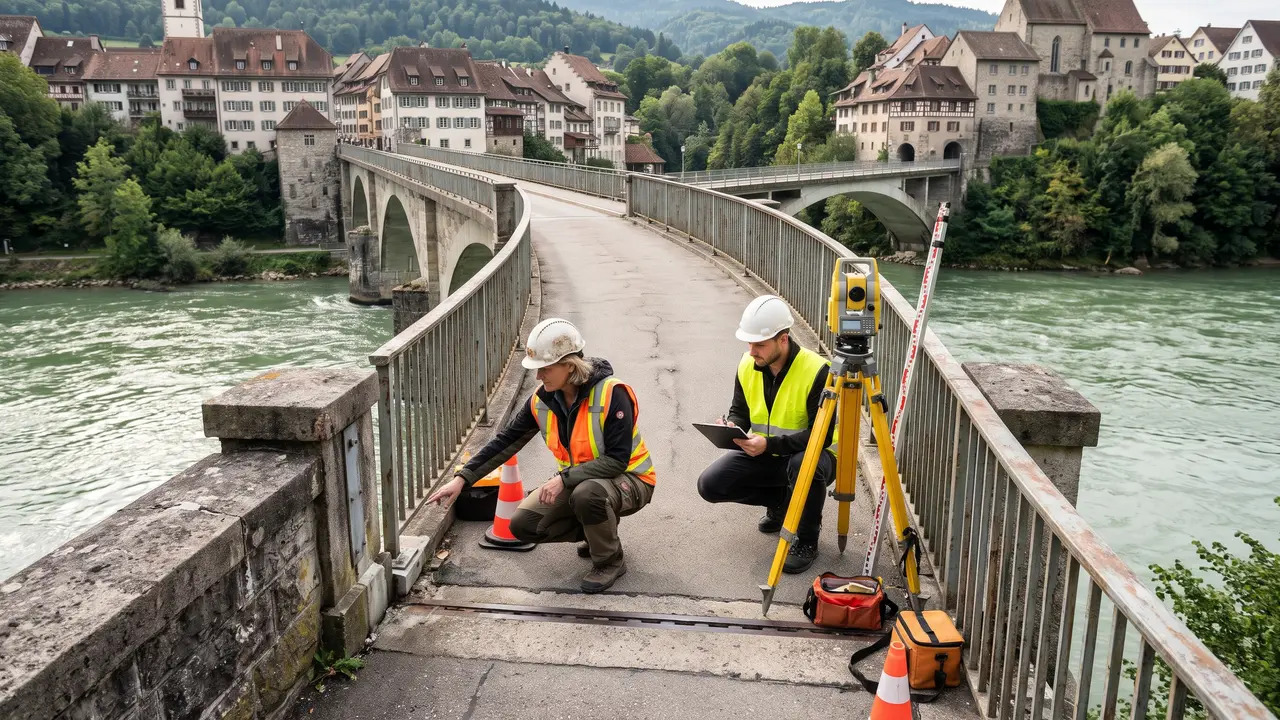
- Scarto sul ponte sul Reno
- 54 cm
- Dislivello tra le spalle a Laufenburg dopo il raddoppio dei 27 cm tra i due mari[1]
- Quota d'impatto su Marte
- 57 km
- Altitudine reale del Mars Climate Orbiter contro gli 85 km minimi di sopravvivenza[4]
- Fattore errato a Gimli
- 1,77 lb/L
- Densità in libbre per litro applicata al Boeing 767 metrico al posto di 0,8 kg/L[3]
In questo articolo
Salta a una sezione
Perché i disastri metrologici nascono quasi sempre al confine tra due sistemi
| Caso ingegneristico | Parametro atteso | Valore applicato | Effetto fisico |
|---|---|---|---|
| Ponte Hochrheinbrücke (2003) | Compensazione di +27 cm tra i due mari | Sottrazione di 27 cm per errore di segno | Gradino verticale di 54 cm tra le due spalle[1] |
| Mars Climate Orbiter (1999) | Impulso in newton·secondo (N·s) | Impulso in libbre-forza·secondo (lbf·s) | Ingresso nell'atmosfera a 57 km e distruzione[2][4] |
| Air Canada 143 Gimli (1983) | Densità cherosene di 0,8 kg/L | Fattore imperiale di 1,77 lb/L | Serbatoi a metà carico e spegnimento a 41.000 piedi[3][8] |
Il ponte di Laufenburg sul Reno e il gradino di 54 centimetri tra due mari
373,6 m
Dal masso Pierre du Niton alle reti altimetriche svizzere LN02 e LHN95
L'errore di segno sulla spalla svizzera e la correzione sul lato tedesco
Mars Climate Orbiter: il fattore 4,45 che ha bruciato la sonda NASA su Marte
- Mancata verifica end-to-end del software di navigazione e dei modelli informatici associati prima del lancio.[18]
- Assenza di revisioni paritarie (peer review) indipendenti sui calcoli del team di navigazione.[18]
- Comunicazioni troppo informali tra i gruppi di lavoro e scarso addestramento sull'uso formale dei rapporti di anomalia (Incident, Surprise, Anomaly).[18]
- Mancata esecuzione della manovra correttiva finale di traiettoria (TCM-5) nelle ore precedenti l'arrivo su Marte.[18]
Il volo Air Canada 143 e l'errore tra libbre e chilogrammi a 41.000 piedi
Da leggere · Grandi Opere e Strutture
Sarcofago di Chernobyl: come l'arco NSC ferma ruggine e polveri
Perché l'aviazione vola ancora in piedi e come si blindano oggi le interfacce
Il pericolo delle fasi di transizione mista
- Tipizzazione forte delle grandezze fisiche: nei linguaggi di programmazione per l'aerospazio e l'automazione, i valori di spinta, massa o pressione non viaggiano come semplici numeri in virgola mobile (float), ma come tipi di dato vincolati all'unità del Sistema Internazionale che impediscono la compilazione se si sommano libbre e newton.[2][17]
- Validazione end-to-end sulle interfacce (SIS/ICD): ogni scambio dati tra appaltatore e centro di controllo richiede test d'integrazione incrociati e revisioni indipendenti sui valori di soglia prima del lancio.[5][18]
- Unificazione geodetica e telemetria invariante: così come i transponder aeronautici fissano il riferimento a 1013,2 hPa e la geodesia migra verso il potenziale gravitazionale dell'IHRS, anche la stabilità di frequenza nelle reti energetiche dipende da riferimenti fisici assoluti, come avviene con i compensatori sincroni che forniscono inerzia alla rete elettrica quando la generazione cambia scala.[7][21]
Domande frequenti
Quali sono i più famosi errori di ingegneria sulle unità di misura nella storia recente?
Perché il ponte di Laufenburg tra Svizzera e Germania era disallineato di 54 centimetri?
Come è stato risolto l'errore di quota sulla Hochrheinbrücke di Laufenburg?
Quale calcolo sbagliato ha distrutto la sonda Mars Climate Orbiter nel 1999?
Perché il Boeing 767 del volo Air Canada 143 è rimasto senza carburante in volo?
Perché nell'aviazione civile si usano ancora i piedi invece dei metri per l'altitudine?
Fonti
21 riferimenti Mostra Nascondi
- Hochrheinbrücke (Laufenburg) (si apre in una nuova scheda)
«Wegen eines Vorzeichenfehlers wurde das Schweizer Widerlager jedoch 27 cm niedriger erstellt. Somit wuchs der Höhenunterschied mit insgesamt 54 cm auf doppelte Differenz.»
- Mars Climate Orbiter Investigation Summary (si apre in una nuova scheda)
«Specifically, software that calculated the total impulse produced by thruster firings produced results in pound-force seconds. The trajectory calculation software then used these results – expected to be in newton-seconds (incorrect by a factor of 4.45)[2] – to update the predicted position of the spacecraft.»
- The Gimli Glider (Air Canada Flight 143) (si apre in una nuova scheda)
«However, unbeknownst to the pilots and the fuel crew, this multiplier provided the weight in imperial pounds; the new, all-metric 767 was based on kilograms, and required a multiplier of 0.8.»
- NASA NSSDCA — Mars Climate Orbiter (1998-073A) (si apre in una nuova scheda)
«The Mars Climate Orbiter was destroyed when a navigation error caused it to miss its target altitude at Mars by 80 to 90 km, instead entering the martian atmosphere at an altitude of 57 km during the orbit insertion maneuver.»
- NASA Release 99-113 (30 Sep 1999) (si apre in una nuova scheda)
«"People sometimes make errors," said Dr. Edward Weiler, NASA's Associate Administrator for Space Science. "The problem here was not the error, it was the failure of NASA's systems engineering, and the checks and balances in our processes to detect the error. That's why we lost the spacecraft."»
- BBC News — Great Miscalculations (2014) (si apre in una nuova scheda)
«Archaeologists have found four rulers used by the workmen who built the ship. Two were calibrated in Swedish feet, which had 12 inches, while the other two measured Amsterdam feet, which had 11 inches.»
- IAG GGOS — International Height Reference Frame (si apre in una nuova scheda)
«Presently, there are about hundred local and regional height systems in use, and they exhibit discrepancies with respect to each other up to 2 m.»
- Air Canada Flight 143 (Gimli Glider) (si apre in una nuova scheda)
«Instead of taking on the 20,088 litres (4,419 imp gal; 5,307 US gal) of additional fuel that they required, they took on only 4,917 litres (1,082 imp gal; 1,299 US gal). The use of the incorrect conversion factor led to a total fuel load of only 22,300 lb (10,100 kg) rather than the 49,170 lb (22,300 kg) that were needed.»
- Hochrheinbrücke — Bau und Korrektur (si apre in una nuova scheda)
«Der sich anbahnende Unterschied wurde bei einer Begehung im Dezember 2003 bemerkt und konnte entsprechend frühzeitig beseitigt werden. Die Brückenbaustelle geriet aufgrund des Planungsfehlers in die Schlagzeilen. Die Folge waren Korrekturmaßnahmen am deutschen Widerlager und Höhenangleichungen des Brückenüberbaus.»
- Hochrheinbrücke — Technische Daten (si apre in una nuova scheda)
«Die Spannbetonbrücke besitzt eine Länge von 225 m. Sie weist in Längsrichtung den Durchlaufträger als Bauwerkssystem auf. Die Stützweiten betragen für die dreifeldrige Straßenüberführung 95 m im mittleren Feld und 65 m in den beiden Randfeldern.»
- BBC News — Laufenburg Bridge Datum Error (si apre in una nuova scheda)
«As two halves of a new bridge grew closer to one another in 2003, it became clear that, instead of being at the same height "above sea level", one side was 54cm higher than the other. Builders knew that there was a 27cm difference between the two versions of sea level - but somehow it was doubled, rather than cancelled out.»
- swisstopo — Geodäsie und Repère Pierre du Niton (si apre in una nuova scheda)
«Als offizieller Wert («Neuer Horizont») wurde 1902 die Höhe von 373.6 m eingeführt, also ganze 3.26 m tiefer!»
- swisstopo — Einführung des neuen Horizonts 1902 (si apre in una nuova scheda)
«Trotz grosser Bemühungen, die Fachwelt über die Änderung zu informieren, setzten sich vor rund hundert Jahren die Höhen vor allem bei den Anwendern im Ingenieur- und Bauwesen nur langsam durch, weshalb es zu vielen Problemen mit Verwechslungen bei den Höhenangaben kam.»
- swisstopo — Landesnivellementnetz LN02 (si apre in una nuova scheda)
«Es besteht aus insgesamt 18 Hauptschleifen und zusätzlichen Nebenlinien mit ca. 8000 Nivellementfixpunkten (Bolzen), welche gruppenweise im Abstand von 1-2 km entlang dem schweizerischen Hauptstrassennetz angeordnet sind.»
- swisstopo — Landeshöhennetz LHN95 (si apre in una nuova scheda)
«Diese Höhen sind vor allem für die Landesvermessung von Bedeutung und unterscheiden sich von den LN02-Höhen (offizielle Gebrauchshöhen der Schweiz) um maximal 50 cm.»
- NASA JPL — Mars Climate Orbiter Arrival Statement (23 Sep 1999) (si apre in una nuova scheda)
«"We had planned to approach the planet at an altitude of about 150 kilometers (93 miles). We thought we were doing that, but upon review of the last six to eight hours of data leading up to arrival, we saw indications that the actual approach altitude had been much lower. It appears that the actual altitude was about 60 kilometers (37 miles). We are still trying to figure out why that happened," said Richard Cook, project manager for the Mars Surveyor Operations Project at NASA's Jet Propulsion Laboratory. "We believe that the minimum survivable altitude for the spacecraft would have been 85 kilometers (53 miles)."»
- NASA Release 99-134 — MCO Investigation Board Report (10 Nov 1999) (si apre in una nuova scheda)
«"The 'root cause' of the loss of the spacecraft was the failed translation of English units into metric units in a segment of ground-based, navigation-related mission software, as NASA has previously announced," said Arthur Stephenson, chairman of the Mars Climate Orbiter Mission Failure Investigation Board.»
- NASA Release 99-134 — Contributing Factors (si apre in una nuova scheda)
«The failure board's first report identifies eight contributing factors that led directly or indirectly to the loss of the spacecraft. These contributing causes include inadequate consideration of the entire mission and its post-launch operation as a total system, inconsistent communications and training within the project, and lack of complete end-to-end verification of navigation software and related computer models.»
- The Gimli Glider — Emergency Systems and RAT (si apre in una nuova scheda)
«Onboard batteries revived a few of the most critical instruments, and a door popped open on the plane’s underbelly to expose a ram-air turbine (RAT) designed to provide limited emergency hydraulic support.»
- SKYbrary — Altitude, Flight Level and Height (ICAO Annex 5) (si apre in una nuova scheda)
«The primary unit of measurement of altitude and elevation or height is the metre. However, the most widely used unit of measurement in aviation is the foot. Metric altitudes and flight levels are used in certain countries. ICAO Annex 5 and Supplement give a partial listing of the units of measurement used in most countries.»
- SKYbrary — Altimeter Setting Procedures (si apre in una nuova scheda)
«Transponder level replies are always based on standard pressure irrespective of the altimeter setting. This value is then converted to QNH by the ground system if necessary.»