Tunnel di Williamson a Liverpool: filantropia o cava?
Chi fece scavare i tunnel di Williamson a Liverpool e perché? Cava di arenaria o filantropia: date, misure e visite a Edge Hill, ogni cifra con la sua fonte.
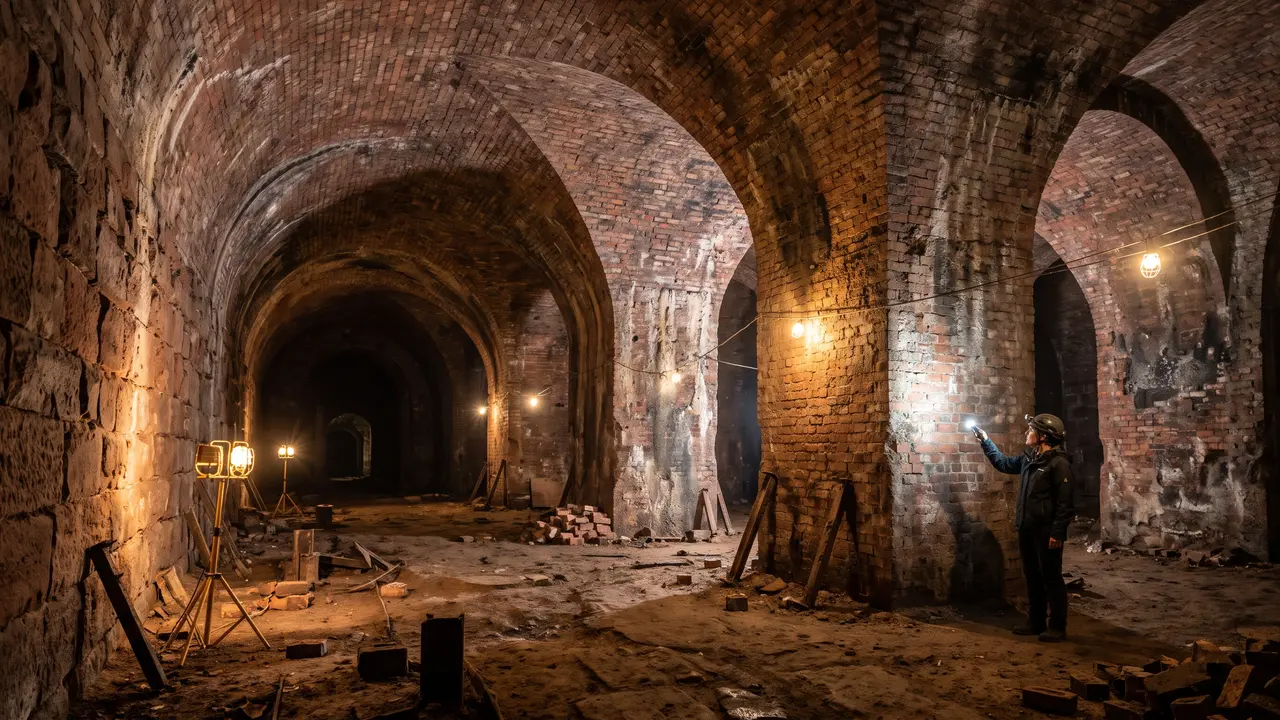
I tunnel noti stanno tutti dentro un rettangolo largo 300 metri, tra Paddington e Grinfield Street.
- Periodo dei lavori
- 1810-1840
- Datazione ritenuta per la creazione dei tunnel, con inizi diversi altrove[2]
In questo articolo
Salta a una sezione
Joseph Williamson e le date che non coincidono
- Nel 1805 Williamson acquisì un terreno a Mason Street, in gran parte non edificato e segnato da piccole cave di arenaria.[11]
- Nel 1806 ottenne in affitto la Long Broom Field dalla West Derby Waste Lands Commission, secondo l'analisi di Lucas, Bridson e Jones.[12]
- Intorno al 1815 iniziò a costruire i tunnel, per Subterranea of Great Britain, con un'intensificazione dopo la morte della moglie nel 1822.[13]
Un terreno di arenaria, con cave in affitto
Come sono costruite le volte e quanto sono grandi
Perché li scavò: le teorie e chi le sostiene
- Filantropia: l'idea nasce soprattutto dagli scritti di James Stonehouse e Charles Hand,[37] e a Williamson si attribuisce la spiegazione dell'«impiego dei poveri».[38]
- Cava restaurata: gli autori dello studio di Edge Hill sostengono che fossero cave di pietra da costruzione ripristinate con una tecnica nuova, non tunnel scavati per filantropia.[4] La loro conclusione è che lo scopo fosse in gran parte un'industria estrattiva redditizia per un mercato urbano esigente.[39]
- Follia eccentrica: Stonehouse e Hand ritenevano gli scavi la follia in gran parte priva di scopo di un uomo eccentrico.[40]
- Setta religiosa: non esistono prove di una setta né di un'appartenenza di Williamson, praticante anglicano,[41] anche se il FoWT ha esplorato una pista su un gruppo religioso che attendeva la fine del mondo.[42]
- Contrabbando: per il FoWT è improbabile, perché la posizione è sbagliata.[43]
Discariche, rilievi e volontari: dall'oblio alla riscoperta
Da leggere · Grandi Opere e Strutture
Perché il tunnel di Gibilterra non è ancora stato costruito
Visitare i tunnel: Paddington gratis, Heritage Centre a pagamento
Il Banqueting Hall non è nel tour gratuito
Domande frequenti
Dove si trovano i tunnel di Williamson a Liverpool?
Chi ha costruito i tunnel di Williamson?
Perché Joseph Williamson fece scavare i tunnel?
I tunnel di Williamson sono aperti al pubblico?
Fonti
66 riferimenti Mostra Nascondi
- Friends of Williamson's Tunnels: introduzione (si apre in una nuova scheda)
«The Williamson Tunnels are a labyrinth of tunnels and underground caverns under the Edge Hill district of Liverpool in north-west England.»
- Williamson Tunnels (Wikipedia) (si apre in una nuova scheda)
«They are thought to have been created under the direction of tobacco merchant, landowner and philanthropist Joseph Williamson between 1810 and 1840.»
- Lucas, Bridson e Jones: Williamson Tunnels (EIG Conferences) (si apre in una nuova scheda)
«Much of the published literature has suggested they were constructed out of some idiosyncratic philanthropy for unemployed demobbed Napoleonic war veterans.»
- Edge Hill University Research: Williamson Tunnels (si apre in una nuova scheda)
«The authors have reviewed the evidence for their origin and dispute that they were the burrowings of a philanthropist, instead arguing that they were dimension stone quarries that were restored to good land by a novel technique.»
- Williamson Tunnels (Wikipedia): visite (si apre in una nuova scheda)
«The general public can visit the "Paddington" site with free guided tours on Wednesdays and Sundays»
- Lucas, Bridson e Jones: stima dell'arenaria rimossa (EIG Conferences) (si apre in una nuova scheda)
«Assuming a conservative and average depth of excavation of 7m the authors have arrived at a figure of nearly 123,000 tonnes of sandstone removed over aperiod of 30-35 years.»
- Friends of Williamson's Tunnels: la storia di Williamson (si apre in una nuova scheda)
«Joseph Williamson was born on 10th March 1769. His place of birth is not definitely proven, but is widely believed to be Warrington.»
- Joseph Williamson (Wikipedia): luogo di nascita (si apre in una nuova scheda)
«However, research by staff and volunteers of the Williamson Tunnels Heritage Centre has shown that he was born in the West Riding of Yorkshire»
- Joseph Williamson (Wikipedia): morte (si apre in una nuova scheda)
«Williamson died in 1840 aged 71 at his home in Mason Street, the cause of death being "water on the chest"»
- Friends of Williamson's Tunnels: la fine dei lavori (si apre in una nuova scheda)
«The tunnelling stopped immediately and was never continued.»
- Williamson Tunnels (Wikipedia): terreno del 1805 (si apre in una nuova scheda)
«In 1805, wealthy businessman Joseph Williamson acquired an area of land in Mason Street, Edge Hill, Liverpool, which was then a largely undeveloped outcrop of sandstone with a scattering of scars from small-scale quarrying.»
- Lucas, Bridson e Jones: affitto del 1806 (EIG Conferences) (si apre in una nuova scheda)
«After securing the lease to a steeply sloping piece of waste land called ‘Long Broom Field’ from the West Derby Waste Lands Commission in 1806»
- Subterranea of Great Britain: Williamson Tunnels (si apre in una nuova scheda)
«he started building the tunnels around 1815, but intensified his work after the death of his wife in 1822.»
- Friends of Williamson's Tunnels: durata del progetto (si apre in una nuova scheda)
«if you look at the 35 years or so that the project lasted (until Williamson died)»
- CNN (via CP24): i tunnel di Liverpool (si apre in una nuova scheda)
«And he spent 34 years up here having his men digging out the sandstone and building houses over the top in many cases.»
- Lucas, Bridson e Jones: geologia (EIG Conferences) (si apre in una nuova scheda)
«The area including and adjacent to the excavations is in the Upper Pebble Beds of the Bunter (now the Chester Pebble Beds in the Sherwood Sandstone Group)»
- Edge Hill University Research: i 15 tunnel (si apre in una nuova scheda)
«The Williamson ‘tunnels’ are a hidden labyrinth of around 15 ‘tunnels’ cut into Permo-Triassic sandstone in what is now a suburb of Liverpool.»
- Williamson Tunnels (Wikipedia): affitto e diritti minerari (si apre in una nuova scheda)
«The land was held under a lease from the West Derby Waste Commissioners, who retained rights to the minerals under it»
- Lucas, Bridson e Jones: tunnel come cave (EIG Conferences) (si apre in una nuova scheda)
«Although the excavations as they are seen today appear to be ‘tunnels’, at the time of Williamson they were quarries.»
- Lucas, Bridson e Jones: pianta di Stonehouse (EIG Conferences) (si apre in una nuova scheda)
«According to Stonehouse’s plan of 1846 there appears to have been one, possibly two, large square based quarries»
- CNN (via CP24): il terreno del 1806 (si apre in una nuova scheda)
«When Joseph Williamson bought land in Edge Hill in 1806, it was with an eye to creating a well-to-do suburb»
- Friends of Williamson's Tunnels: gli archi del 1806 (si apre in una nuova scheda)
«By 1806, with several houses under construction at once and the arches taking shape behind them»
- Friends of Williamson's Tunnels: gli operai (si apre in una nuova scheda)
«it wasn’t really Williamson himself, but rather the hundreds of workers he eventually employed who did the work»
- Lucas, Bridson e Jones: nessun condotto in roccia (EIG Conferences) (si apre in una nuova scheda)
«There is not a single example of the existing ‘tunnels’ that is solely hewn out of sandstone in the form of a conduit.»
- Lucas, Bridson e Jones: volte sovrapposte (EIG Conferences) (si apre in una nuova scheda)
«in order to bridge the voids arches were piggybacked to make double or triple decker ‘tunnels’.»
- Friends of Williamson's Tunnels: archi che non portano da nessuna parte (si apre in una nuova scheda)
«In the parts of the tunnels accessible today there is evidence of tunnels being built and bricked up again, alongside fine arches that lead nowhere.»
- Friends of Williamson's Tunnels: misure del Banqueting Hall (si apre in una nuova scheda)
«The so-called ‘banqueting hall’ is about 64 feet long, 14 feet wide and 27 feet high.»
- Williamson Tunnels (Wikipedia): Banqueting Hall (si apre in una nuova scheda)
«The "Banqueting Hall" is around 60 feet (18 m) long and up to 27 feet (8.2 m) high»
- Grace's Guide: Williamson Tunnels (si apre in una nuova scheda)
«They vary in size from the "banqueting hall", which is about 70 feet long, between 20 feet and 25 feet wide and 20 feet high»
- Williamson Tunnels (Wikipedia): camera di Paddington (si apre in una nuova scheda)
«The floor of this chamber is approximately 60 feet (18 m) below ground level and was cleared in 2016 after several years of excavation.»
- Friends of Williamson's Tunnels: il rettangolo dei tunnel noti (si apre in una nuova scheda)
«The known tunnels are all within the confines of the 300 metre-wide rectangle of land bordered by Paddington and Grinfield Street.»
- Williamson Tunnels (Wikipedia): estensione (si apre in una nuova scheda)
«Their full extent is unknown and many are still blocked by rubble.»
- Friends of Williamson's Tunnels: scopo non noto (si apre in una nuova scheda)
«The purpose of their construction is not known with any certainty.»
- Subterranea of Great Britain: Williamson Tunnels (scopo) (si apre in una nuova scheda)
«we have no idea why he built them»
- Friends of Williamson's Tunnels: la riservatezza di Williamson (si apre in una nuova scheda)
«Williamson was very secretive about his tunnels, never stating their purpose except for a few reported conversations»
- CNN (via CP24): nessun registro scritto (si apre in una nuova scheda)
«Williamson never spoke of his plans publicly, was never known to invite anybody to see what was happening, and left no written records or maps that might shed light on the tunnels’ purpose or even their extent.»
- Friends of Williamson's Tunnels: origine dell'ipotesi filantropica (si apre in una nuova scheda)
«The suggestion that it was stems largely from the old writings of James Stonehouse and Charles Hand»
- Williamson Tunnels (Wikipedia): spiegazione attribuita a Williamson (si apre in una nuova scheda)
«Williamson's own explanation was reputed to be that his motive was "the employment of the poor"»
- Lucas, Bridson e Jones: industria estrattiva (EIG Conferences) (si apre in una nuova scheda)
«pointed to their purpose being largely part of a profitable extractive stone industry to supply a demanding urban market.»
- Williamson Tunnels (Wikipedia): follia eccentrica (si apre in una nuova scheda)
«Stonehouse and Hand both felt the excavations were simply the largely purposeless folly of an eccentric man.»
- Williamson Tunnels (Wikipedia): ipotesi della setta (si apre in una nuova scheda)
«No evidence has been found to support the existence of such a sect or that Williamson, a practising member of the Church of England, belonged to one.»
- Friends of Williamson's Tunnels: la pista religiosa (si apre in una nuova scheda)
«At FoWT we did explore a lead which suggested Williamson subscribed to one of the religious groups prevalent at the time which claimed the world would end soon»
- Friends of Williamson's Tunnels: contrabbando (si apre in una nuova scheda)
«Suggestions that the tunnels were used for smuggling are unlikely to be true: their location is wrong for that»
- Williamson Tunnels (Wikipedia): compiti inutili (si apre in una nuova scheda)
«he occasionally engaged them to carry out apparently pointless tasks, such as moving rubble from one place to another, then back again.»
- CNN (via CP24): buche riempite di nuovo (si apre in una nuova scheda)
«Sometimes, men were simply digging holes and filling them back up again.»
- CNN (via CP24): la spiegazione più probabile (si apre in una nuova scheda)
«The most likely explanation for the endless tunnel-building is philanthropy: providing honest work and skill-building for men at a time when living was tough.»
- Williamson Tunnels (Wikipedia): riempimento con macerie (si apre in una nuova scheda)
«In the later 19th century the Corporation of Liverpool began backfilling the tunnels with rubble and other waste from building demolition, a process that continued sporadically into the 20th century.»
- Lucas, Bridson e Jones: cantine e rifiuti (EIG Conferences) (si apre in una nuova scheda)
«The residents made use of the subterranean caverns as cellars primarily for the disposal of their night soils and household rubbish.»
- Grace's Guide: i drenaggi nei tunnel (si apre in una nuova scheda)
«because drains ran straight into them, in one place creating a cess pool full of offensive water 15 feet deep»
- Williamson Tunnels (Wikipedia): rilievo del 1881 (si apre in una nuova scheda)
«In 1881, the North Staffordshire Institute of Mining and Mechanical Engineers conducted a field trip to Liverpool during which they surveyed some of the surviving excavations, producing a plan and dog-leg section of the main parts of the site.»
- Grace's Guide: la mappa del 1907 (si apre in una nuova scheda)
«In 1907 the Association produced a map of the tunnels, which was incomplete because many of them were filled with rubble.»
- CNN (via CP24): i rilievi del 1926 (si apre in una nuova scheda)
«Interest was revived just over a century ago after a series of articles by the historian Charles Hand was the catalyst for official surveys being carried out in 1926.»
- Friends of Williamson's Tunnels: nessuna mappa completa (si apre in una nuova scheda)
«no comprehensive map has ever been found»
- Williamson Tunnels (Wikipedia): inaccessibili fino al 1995 (si apre in una nuova scheda)
«After being gradually infilled with rubble and spoil during the late 19th and early 20th centuries, they remained largely inaccessible until archaeological investigations were carried out in 1995.»
- Williamson Tunnels (Wikipedia): rilievo micro-gravimetrico (si apre in una nuova scheda)
«In 1995 a geology student from Liverpool University carried out a micro-gravity survey of the site.»
- CNN (via CP24): la ricerca del 1999 (si apre in una nuova scheda)
«We were searching for a way into the long-lost cellar system below these long-lost buildings in 1999»
- Grace's Guide: lo svuotamento di Paddington (si apre in una nuova scheda)
«The Friends emptied this site in just under four years and 159 skips.»
- Williamson Tunnels (Wikipedia): apertura dell'Heritage Centre (si apre in una nuova scheda)
«In autumn 2002, after much excavation, removal of rubble and renovation, one of the three sections of the site, the Stable Yard section, was opened to the public as the Williamson Tunnels Heritage Centre»
- CNN (via CP24): le due associazioni (si apre in una nuova scheda)
«The Joseph Williamson Society was founded in 1989, giving rise eventually, and somewhat confusingly, to the two separate groups preserving the site today.»
- Williamson Tunnels (Wikipedia): il Friends of Williamson's Tunnels (si apre in una nuova scheda)
«The Friends of Williamson's Tunnels (FoWT) is a registered charity, managed by a board of trustees and committed to exploring, excavating and preserving the tunnels, with the work of excavation carried out by volunteers.»
- Friends of Williamson's Tunnels: Heritage Centre (si apre in una nuova scheda)
«The Heritage Centre on Smithdown Lane has a section of the tunnels renovated and open for paid visits.»
- Friends of Williamson's Tunnels: sedi (si apre in una nuova scheda)
«Friends of Williamson’s Tunnels (FoWT): Joseph Williamson’s House site, Mason Street, Edge Hill, Liverpool, L7 3EW.»
- Subterranea of Great Britain: indirizzo dell'Heritage Centre (si apre in una nuova scheda)
«Williamson Tunnels Heritage Centre, The Old Stableyard, Smithdown Lane, Liverpool, L7 3EE»
- Friends of Williamson's Tunnels: visitare i tunnel (si apre in una nuova scheda)
«The Paddington site is only half the story, but by taking out a membership, you will get to see a lot more, including the famous Banqueting Hall beneath the site of Joseph Williamson’s house.»
- Williamson Tunnels (Wikipedia): ubicazione (si apre in una nuova scheda)
«The known tunnels are in an area to the east of the Roman Catholic Liverpool Metropolitan Cathedral in a rectangle bordered by Mason Street, Grinfield Street, Smithdown Lane and Paddington.»
- Williamson Tunnels (Wikipedia): ipotesi sullo scopo (si apre in una nuova scheda)
«The purpose of the works remains unclear and remains a subject of heavy speculation; suggestions include commercial quarrying, a philanthropic desire to provide employment, and Williamson's own eccentric interests.»