Perché la torre di Šuchov è un iperboloide di travi dritte
Torre radio di Mosca alta 160 m, finita nel 1922 con travi dritte e sei sezioni iperboloidi montate a telescopio: com'è fatta e cosa prevede il progetto.
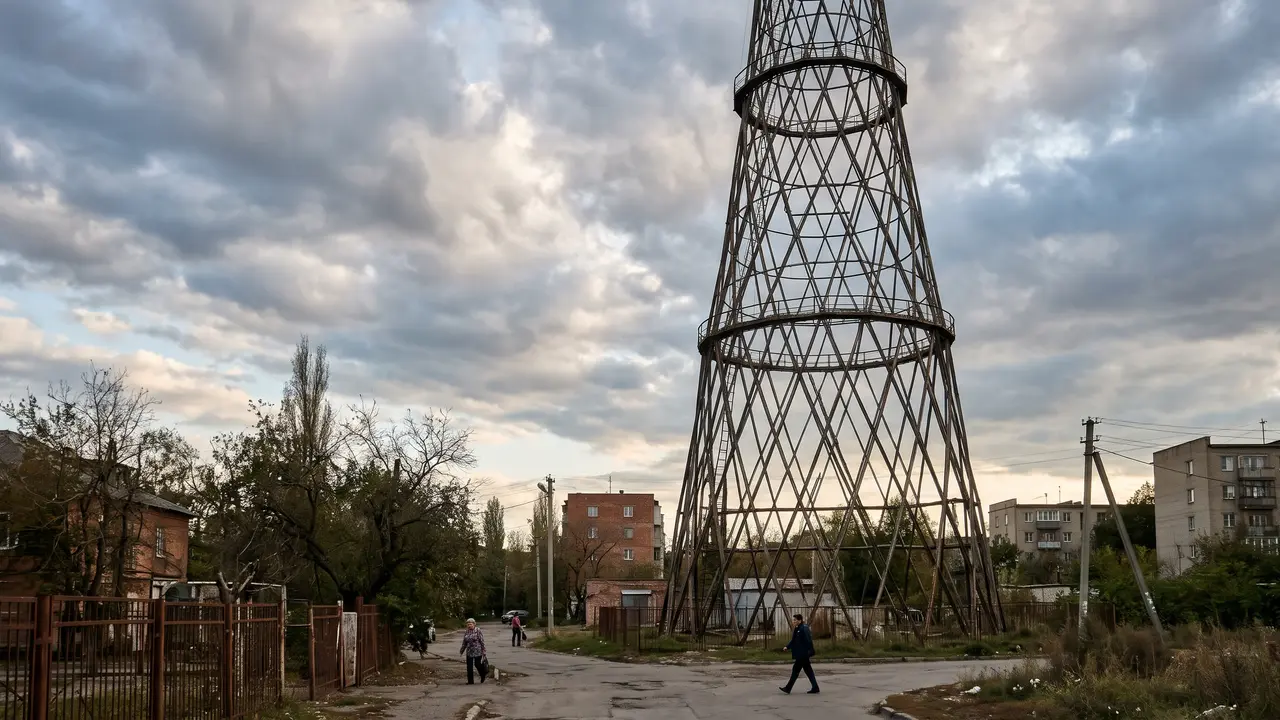
La struttura a iperboloide di Šuchov sfrutta aste d'acciaio lineari per formare una superficie rigata autoportante.
- Sesta sezione installata
- 14 feb 1922
- La sesta sezione fu installata e fissata in via definitiva.[43]
In questo articolo
Salta a una sezione
Perché bastano travi dritte per fare una curva
Dal brevetto alle altre torri di Šuchov
Dal progetto da 350 metri alle 240 tonnellate
240 t
Montaggio telescopico, senza gru né ponteggi
La torre oggi: ferma dal 2002, smontaggio approvato nel 2026
Da leggere · Grandi Opere e Strutture
Sarcofago di Chernobyl: come l'arco NSC ferma ruggine e polveri
2014: la demolizione evitata
Il progetto approvato nel 2026
Domande frequenti
Come funziona la torre Shukhov, iperboloide d'acciaio, e perché usa solo travi dritte?
Quanto è alta la torre radio di Šuchov a Mosca?
Quanto pesa la torre di Šuchov rispetto alla Torre Eiffel?
Come fu montata la torre senza grandi gru o ponteggi?
Quando fu brevettato l'iperboloide di Šuchov?
Quando partì la prima trasmissione radio dalla torre?
Fonti
59 riferimenti Mostra Nascondi
- Wikipedia: Shukhov Tower (si apre in una nuova scheda)
«The tower sections are single-cavity hyperboloids of rotation made of straight beams, the ends of which rest against circular foundations.»
- The Moscow Times (si apre in una nuova scheda)
«At the time of its unveiling in 1922, the tower was the tallest structure in Russia at 160 meters high.»
- Mos.ru: Glavarchiv di Mosca (si apre in una nuova scheda)
«Конструкция состоит из шести сетчатых гиперболоидных стальных секций-ярусов.»
- Meduza (si apre in una nuova scheda)
«The Main State Expert Review Board approved the project on April 3, 2026.»
- Wolfram MathWorld: Hyperboloid (si apre in una nuova scheda)
«The one-sheeted hyperboloid is a surface of revolution obtained by rotating a hyperbola about the perpendicular bisector to the line between the foci»
- Wikipedia: Hyperboloid structure (si apre in una nuova scheda)
«As doubly ruled surfaces, they can be made with a lattice of straight beams»
- Meduza (si apre in una nuova scheda)
«if it had 48 supports, as the Shabolovka hyperboloid does, each carried one forty-eighth of the total weight.»
- Meduza (si apre in una nuova scheda)
«Archival drawings suggest that the Shabolovka tower’s supports extend only three meters (about 10 feet) into the ground»
- Etudes.ru: Torre Šuchov (si apre in una nuova scheda)
«Привилегiя, выданная 12 Марта 1899 года.»
- Meduza (si apre in una nuova scheda)
«One of Shukhov’s patents covered lattice hyperboloid structures.»
- Wikipedia: Vladimir Shukhov (si apre in una nuova scheda)
«The thermal cracking method, the Shukhov cracking process, was patented by Vladimir Shukhov in 1891.»
- Wikipedia: Hyperboloid structure (si apre in una nuova scheda)
«A hyperboloid cooling tower by Frederik van Iterson and Gerard Kuypers was patented in the Netherlands on August 16, 1916.»
- Etudes.ru: Torre Šuchov (si apre in una nuova scheda)
«Сѣтчатая поверхность, образующая башню предлагаемаго устройства, состоитъ изъ прямыхъ деревянныхъ брусьевъ, желѣзныхъ трубъ и уголковъ»
- Wikipedia: Vladimir Shukhov (si apre in una nuova scheda)
«Eight thin-shell structures exhibition pavilions for the All-Russia Exhibition in Nizhny Novgorod of 1896»
- Wikipedia: Hyperboloid structure (si apre in una nuova scheda)
«Two pavilions of this type were built for the Nizhni Novgorod exposition, one oval in plan and one circular.»
- Wikipedia: Shukhov Rotunda (si apre in una nuova scheda)
«The Rotunda was 16 metres (52 ft) high with a diameter of 68 metres (223 ft).»
- Wikipedia: Shukhov Rotunda (si apre in una nuova scheda)
«The rotunda was subsequently moved to Yessentuki and demolished in the 1980s.»
- Etudes.ru: Torre Šuchov (si apre in una nuova scheda)
«А перед главным павильоном красовалась изящная водонапорная башня высотой 25,6 метра.»
- Wikipedia: Vladimir Shukhov (si apre in una nuova scheda)
«About 200 original towers (hyperboloid steel gridshells) all over the world, the most famous being the 160-meter-high Shukhov Tower in Moscow (1922) and 70-meter-high Adziogol Lighthouse near Kherson (1910).»
- Wikipedia: Hyperboloid structure (si apre in una nuova scheda)
«Over the next 20 years, he designed and built nearly 200 of these towers, no two exactly alike, most with heights in the range of 12m to 68m.»
- Meduza (si apre in una nuova scheda)
«In 1963, the firm Nikken Sekkei designed a 108-meter (about 350-foot) lattice hyperboloid tower in Kobe, Japan.»
- Meduza (si apre in una nuova scheda)
«In 2003, Swiss architects Daniel Roth and Alexander Komm erected a Shukhov-style structure in Zurich as an experiment.»
- Wikipedia: Shukhov Tower (si apre in una nuova scheda)
«On July 30, 1919, Vladimir Lenin signed a decree of the Council of Workers' and Peasants' Defense»
- Mos.ru: Glavarchiv di Mosca (si apre in una nuova scheda)
«Заказ на ее возведение получила Строительная контора под руководством инженера Владимира Шухова.»
- Wikipedia: Shukhov Tower (si apre in una nuova scheda)
«The planned height of the new nine-sectioned hyperbolic tower was 350 metres (1,150 ft)»
- Wikipedia: Hyperboloid structure (si apre in una nuova scheda)
«Shukhov designed a 350m tower, which would have surpassed the Eiffel Tower in height by 50m, while using less than a quarter of the amount of material.»
- Wikipedia: Hyperboloid structure (si apre in una nuova scheda)
«However, the 2200 tons of steel required to build the tower to 350m were not available.»
- Meduza (si apre in una nuova scheda)
«It would also have used far less metal: 2,200 metric tons (about 2,400 U.S. tons), compared with 7,000 metric tons (about 7,700 U.S. tons) for the Eiffel Tower.»
- Wikipedia: Shukhov Tower (si apre in una nuova scheda)
«the height was reduced to 148.5 metres (487 ft), the weight to 240 tons.»
- Moskvich Magazine (si apre in una nuova scheda)
«Зато весила она всего 240 тонн (парижский шедевр Эйфеля — 7300 тонн).»
- Etudes.ru: Torre Šuchov (si apre in una nuova scheda)
«Шухов разрабатывает новый проект Шабловской (именно так тогда назывался район постройки) радиобашни в расчёте на 150-метровую высоту.»
- Wikipedia: Shukhov Tower (si apre in una nuova scheda)
«The 240 tons of metal was allocated by Lenin’s personal decree from the stocks of the Military Department.»
- Scientific American, 1889 (si apre in una nuova scheda)
«The total weight of iron employed in the structure itself is 7,300 tons.»
- Mos.ru: Glavarchiv di Mosca (si apre in una nuova scheda)
«Самым знаменитым сооружением Владимира Шухова стала радиобашня высотой 160 метров на Шаболовке.»
- CTBUH Skyscraper Center (si apre in una nuova scheda)
«160 m / 525 ft»
- Meduza (si apre in una nuova scheda)
«At 144 meters (about 470 feet), the Shabolovka Tower remained Moscow’s tallest structure until 1953»
- Wikipedia: Shukhov Tower (si apre in una nuova scheda)
«Tower construction was carried out without any cranes and scaffolding, but only with winches.»
- Wikipedia: Shukhov Tower (si apre in una nuova scheda)
«For lifting five wooden winches were used, which were moved to the upper sections.»
- Meduza (si apre in una nuova scheda)
«The tower was erected by a method known as telescopic assembly: all the sections were built at ground level, then raised one after another.»
- Etudes.ru: Torre Šuchov (si apre in una nuova scheda)
«Все секции башни собирались на земле.»
- Mos.ru: Glavarchiv di Mosca (si apre in una nuova scheda)
«Строили сооружение без лесов: сначала собрали нижнюю секцию, затем внутри нее возводили последующие и поднимали наверх с помощью блоков и лебедок.»
- Etudes.ru: Torre Šuchov (si apre in una nuova scheda)
«Подъём второй секции начался 16 апреля 1921 года.»
- Wikipedia: Shukhov Tower (si apre in una nuova scheda)
«The sixth section was installed and finally secured on February 14, 1922.»
- Etudes.ru: Torre Šuchov (si apre in una nuova scheda)
«14 февраля. Поставлено кольцо шестой секции, и башня, таким образом, закончена.»
- Docomomo US (si apre in una nuova scheda)
«The Shukhov Tower on Shabolovka Street in Moscow made its first radio broadcast on March 19, 1922 and its first television broadcast on March 10, 1939.»
- Mos.ru: Glavarchiv di Mosca (si apre in una nuova scheda)
«Сто лет назад, 19 марта 1922 года, на старинной московской улице Шаболовке началось радиовещание с помощью Шуховской башни.»
- Mos.ru: Glavarchiv di Mosca (si apre in una nuova scheda)
«До появления в 1967-м Останкинской телебашни Шуховская башня оставалась не только главным передающим телевизионным центром СССР, но и самым высоким сооружением в стране.»
- Meduza (si apre in una nuova scheda)
«Broadcasting stopped in 2002, and the tower has been out of use ever since.»
- Docomomo US (si apre in una nuova scheda)
«The Ministry of Communications announced on February 4, 2014 that their property, the famous but neglected Shukhov Tower, is in a dangerous state.»
- Docomomo US (si apre in una nuova scheda)
«experts from various fields overwhelmingly agreed that even with corroded elements the tower remains in a stable condition»
- Docomomo US (si apre in una nuova scheda)
«The Change.org petition against the dismantling of the tower currently has nearly 10,000 signatures.»
- Docomomo US (si apre in una nuova scheda)
«there was now only one way to avoid disaster and “save” the tower, and that was by promptly taking it apart and considering a new more visible location for the reconstructed tower.»
- Wikipedia: Shukhov Tower (si apre in una nuova scheda)
«on July 3 the Ministry of Culture of Russia announced that the tower will not be demolished»
- The Moscow Times (si apre in una nuova scheda)
«though the Communications and Mass Media Ministry warned it could still be slated for demolition in the future.»
- Meduza (si apre in una nuova scheda)
«According to a state historical and cultural review dated July 7, 2025, the tower will be dismantled and rebuilt with new metal.»
- Wikipedia: Shukhov Tower (si apre in una nuova scheda)
«In April 2026, Glavgosexpertiza of Russia issued a positive conclusion for a project dedicated to the»
- Meduza (si apre in una nuova scheda)
«This fall, its owner, the Russian Television and Radio Broadcasting Network (RTRS), plans to dismantle almost all of it and replace it with a replica by 2028.»
- Meduza (si apre in una nuova scheda)
«Every element that has lost more than 5% of its load-bearing capacity will be replaced.»
- Meduza (si apre in una nuova scheda)
«RTRS has yet to say when dismantling will take place.»