Black start: perché una centrale spenta non riparte da sola
Perché una centrale elettrica spenta non riparte da sola: come dighe alpine, linee a 380 kV e Terna eseguono il black start dopo un blackout nazionale.
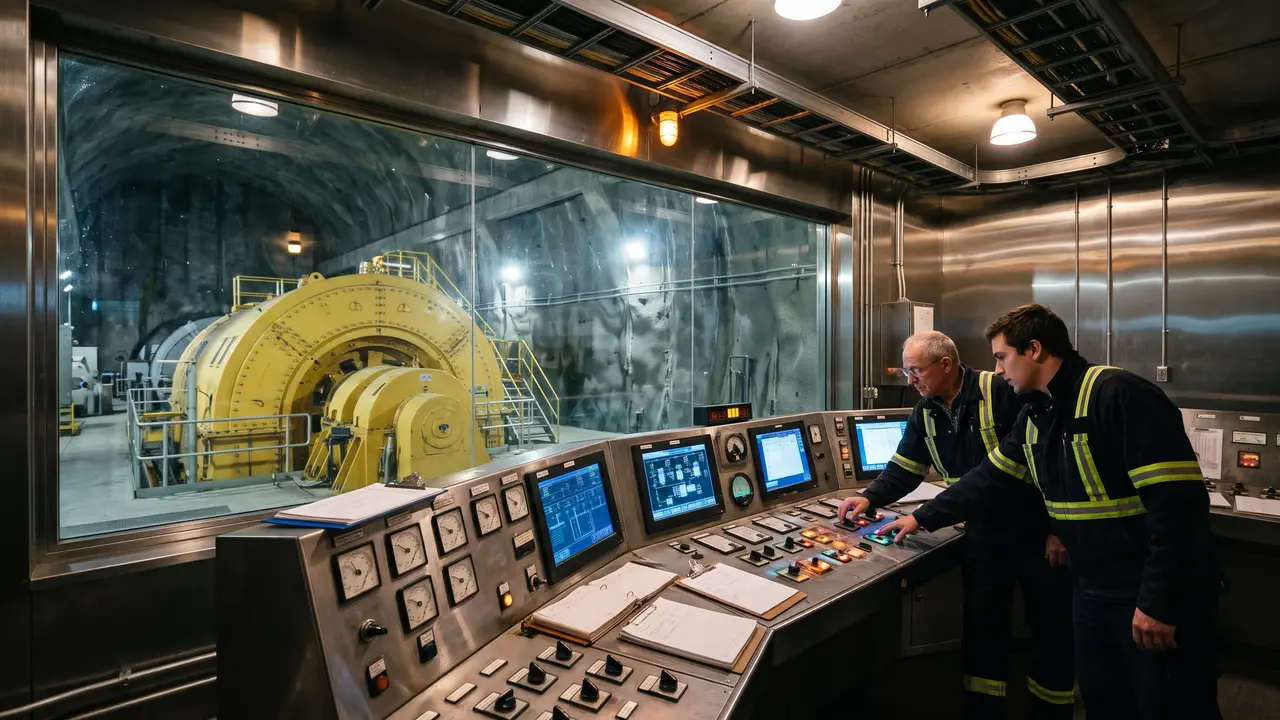
Dopo il blackout del 28 settembre 2003 servirono 18 ore e 12 minuti per rialimentare l'ultimo cliente italiano.
- Fabbisogno dei servizi
- 5%–10%
- Quota della potenza di una centrale a vapore assorbita da pompe e ventilatori interni[1]
- Ripristino blackout 2003
- 18 h 12 min
- Tempo per rialimentare l'ultimo utente italiano dopo oltre 3.600 manovre a 380 kV[2]
- Potenza reattiva a vuoto
- 60 MVAr
- Carica capacitiva generata da 100 km di linea a 400 kV che innesca l'effetto Ferranti[4]
In questo articolo
Salta a una sezione
Perché una centrale elettrica spenta non può accendersi da sola
Come le dighe idroelettriche avviano i corridoi di emergenza
40%
L'effetto Ferranti e l'energizzazione delle dorsali a 380 kV
Cold load pickup e sincronizzazione delle isole elettriche
L'onda d'urto del cold load pickup
- Differenza dell'angolo di fase: gli standard costruttivi IEEE C50.12 e C50.13 impongono per i generatori una finestra massima di ±10 gradi elettrici per evitare coppie meccaniche distruttive sugli alberi.[18]
- Scarto del modulo di tensione: la differenza tra le due sbarre deve restare confinata entro la fascia da 0 a +5% del valore nominale.[18]
- Scorrimento di frequenza (slip): le due isole devono battere quasi allo stesso ritmo, con uno scarto contenuto entro ±0,067 Hz prima del comando di chiusura.[18]
Da leggere · Energia e Reti Elettriche
Agrivoltaico su uliveti e pascoli: perché rende di più a 4 metri
Come Terna testa oggi il piano di riaccensione e la sfida degli inverter
| Strategia o tecnologia | Sorgente di riferimento | Requisiti e limiti operativi |
|---|---|---|
| Rialimentazione top-down | Reti TSO estere via interconnettori | Dipende dalla disponibilità delle linee di confine[20] |
| Riaccensione bottom-up idro/turbogas | Unità nazionali con black start e ILF | Autonomia ausiliari e TLC per 24 ore, test ogni 3 anni[20][21] |
| Inverter rinnovabili grid-following | Circuito PLL agganciato alla rete | Incapaci di partire su sbarra morta senza tensione esterna[23] |
| Batterie BESS con inverter grid-forming | Oscillatore interno di tensione e frequenza | Creano la forma d'onda da zero su rete disalimentata[23] |
Domande frequenti
Come funziona il black start della rete elettrica dopo un blackout nazionale?
Perché una centrale termoelettrica o nucleare non può ripartire da sola al buio?
Quanto tempo ha richiesto il black start dopo il blackout italiano del 28 settembre 2003?
Che cos'è l'effetto Ferranti durante la riaccensione delle linee a 380 kV?
Perché i pannelli solari e le pale eoliche tradizionali non possono riaccendere la rete?
Quali obblighi impone l'Allegato A.10 del Codice di Rete di Terna alle centrali di riaccensione?
Fonti
23 riferimenti Mostra Nascondi
- Wikipedia — Black start (Station service power) (si apre in una nuova scheda)
«Generating plants using steam turbines require station service power of up to 10% of their capacity for boiler feedwater pumps, boiler forced-draft combustion air blowers, and for fuel preparation.»
- UCTE / ENTSO-E — Final Report of the Investigation Committee on the 28 September 2003 Blackout in Italy (Grid restoration metrics) (si apre in una nuova scheda)
«Relevant transmission grid size 245 substations 112 busbar systems at 380 kV Time to reenergise the relevant transmission grid 13 hrs. 30 min. Switching actions in the transmission grid More than 3 600 Events recorded More than 80 000 Estimated energy not supplied 177 GWh Last customer supplied after 18 hrs. 12 min.»
- UCTE / ENTSO-E — Final Report on the 28 September 2003 Blackout in Italy (Black-start units) (si apre in una nuova scheda)
«The restoration paths are initialised by 24 hydro or gas turbine units with black-start capability.»
- Impedyme — Black Start Engineering Resource (Line charging reactive power) (si apre in una nuova scheda)
«Take a 400 kV, 50 Hz overhead line, 100 km long, with an assumed positive-sequence capacitance of about 12 nanofarads per kilometre. Its charging reactive power works out to roughly 60 MVAr.»
- Impedyme — Black Start (Bhatt and Mandi 1999 auxiliary power study) (si apre in una nuova scheda)
«A peer-reviewed study of Indian coal-fired stations (Bhatt and Mandi, 1999, “Performance enhancement in coal-fired thermal power plants. Part III: auxiliary power”) reports that auxiliary power accounts for 7% of gross generated power for 500 MW units and 12% for 30 MW units at full plant load.»
- Practical Engineering — What is a Black Start of the Power Grid (18 MW startup power) (si apre in una nuova scheda)
«Five percent of the nearest plant to my house, even at a quarter of its nameplate capacity, is 18 megawatts. That’s more than 100 of these.»
- Practical Engineering — What is a Black Start of the Power Grid (Excitation) (si apre in una nuova scheda)
«If there’s no excitation current, there’s no magnetic field, which means there’s no power. We’re just spinning two inert coils of wire right next to each other.»
- UCTE / ENTSO-E — Final Report on the 28 September 2003 Blackout in Italy (Excitation system tripping) (si apre in una nuova scheda)
«In many generators, the excitation winding is supplied by the HV, via a step-down transformer and a rectifier (“excitation system”). For the excitation system to work effectively, the supply (grid) voltage needs to remain within a certain range. As a result of the grid fault, local voltage fluctuations rose, causing the tripping of excitation systems.»
- Impedyme — Black Start (Static exciter and field flashing) (si apre in una nuova scheda)
«A static exciter rectifies power taken from the generator terminals or the station bus. On a dead machine there is no terminal voltage to rectify, so it needs an external or stored source to begin. Field flashing solves this: the station battery briefly drives DC into the field until terminal voltage builds enough for the exciter to sustain itself.»
- UCTE / ENTSO-E — Final Report on the 28 September 2003 Blackout in Italy (House-load operation) (si apre in una nuova scheda)
«31 thermal units initiated the sequence for switching on their “house-load”. Only eight of them successfully completed the sequence and remained in isolated operation on house-load.»
- Wikipedia — Black start (Hydroelectric station startup) (si apre in una nuova scheda)
«A hydroelectric station needs very little initial power for starting purposes (just enough to open the intake gates and provide excitation current to the generator field coils) and can put a large block of power on line very quickly to allow start-up of fossil fuel or nuclear stations.»
- Impedyme — Black Start (2019 Oak Ridge National Laboratory hydropower report) (si apre in una nuova scheda)
«A 2019 Oak Ridge National Laboratory report found that hydropower provides about 40% of U.S. black start resources despite representing only about 10% of capacity.»
- UCTE — Interim Report of the Investigation Committee on the 28 September 2003 Blackout in Italy (si apre in una nuova scheda)
«Despite additional load shedding, the frequency continued to decrease and the system collapsed 2 minutes and 30 seconds after the separation of the country, when the frequency reached the threshold of 47.5 Hz.»
- UCTE / ENTSO-E — Final Report on the 28 September 2003 Blackout in Italy (Pumped-storage basins) (si apre in una nuova scheda)
«additionally, as the accident happened before the pumping plants had completed the filling of their upstream basins, in stage 3 of restoration, scarcity of the energy availability of such plants also started to rise.»
- UCTE / ENTSO-E — Final Report on the 28 September 2003 Blackout in Italy (Adriatic backbone overvoltage) (si apre in una nuova scheda)
«From north–east, other 4 substations and the busses of another large thermal plant in Emilia region were re-energised, but the presence of a weak link with the rest of the northern network and the status of the underlying grid prevented the Adriatic backbone from being energised, which would have induced excessive voltages»
- Wikipedia — Ferranti effect (si apre in una nuova scheda)
«In electrical engineering, the Ferranti effect is the increase in voltage occurring at the receiving end of a very long (> 200 km) AC electric power transmission line, relative to the voltage at the sending end, when the load is very small, or no load is connected.»
- Impedyme — Black Start (IEEE PSRC cold load pickup) (si apre in una nuova scheda)
«An IEEE Power System Relaying Committee report documents a cold-load event in which restored current reached 6.7 times the pre-outage current. Peer-reviewed studies describe elevated demand persisting for minutes to tens of minutes until diversity returns.»
- Impedyme — Black Start (IEEE C50.12 and C50.13 synchronization limits) (si apre in una nuova scheda)
«For synchronizing generators, IEEE C50.12 and C50.13 give the machine design limits as a phase angle within ±10 degrees, voltage within 0 to +5 percent, and slip within ±0.067 Hz.»
- UCTE / ENTSO-E — Final Report on the 28 September 2003 Blackout in Italy (Load restoration timeline) (si apre in una nuova scheda)
«after 6 hrs. 30 min load [MW] re-supplied 50 % after 10 hrs. load [MW]re-supplied 70 % after 15 hrs. load [MW] re-supplied 99 % Last customer supplied after 18 hrs. 12 min»
- EUR-Lex — Regolamento (UE) 2017/2196 (Codice di rete su emergenza e ripristino) (si apre in una nuova scheda)
«Il prestatore di servizi di ripristino operante in qualità di gruppo di generazione che fornisce servizi di black start esegue una prova della capacità di black start almeno ogni tre anni, seguendo il metodo di cui all'articolo 45, paragrafo 5, del regolamento (UE) 2016/631.»
- ARERA — Delibera 369/2024/E/eel (Requisiti Allegato A.10 Codice di Rete Terna) (si apre in una nuova scheda)
«più nel dettaglio , la nuova versione dell’Allegato A.10 con i relativi volumi operativi ha modificato e integrat o i requisiti tecnici delle centrali chiamate a svolgere la messa in tensione delle direttrici di riaccensione e successivamente la rialimentazione dei carichi iniziali , prevedendo : - l’installazione dell’integratore locale di frequenza (ILF); - la funzione di ripartenza autonoma (c.d. black start ); - la disponibilità di sistemi di alimentazione di riserva al fine di garantire la conduzione degli impianti e le comunicazioni durante le fasi di ripristino del 3 sistema elettrico per almeno 24 ore (di seguito: sistemi di alimentazione di riserva a 24 ore );»
- Edyna — Prova di riaccensione della fornitura elettrica in Alto Adige con Terna e Alperia (si apre in una nuova scheda)
«Durante l’esercitazione si procederà a scollegare parte dell’Alto Adige dalla rete di trasmissione elettrica nazionale. Il secondo step prevede di servire localmente i comuni interessati con l’energia proveniente dalla centrale idroelettrica Alperia di Naturno tramite la rete Edyna, affiliata Alperia, per poi ricollegarli alla rete di trasmissione nazionale di Terna.»
- Impedyme — Black Start (Grid-following vs grid-forming inverters) (si apre in una nuova scheda)
«A grid-following inverter cannot start on a dead bus for a concrete reason: its PLL has no voltage to lock to.»