Come fanno le caverne saline a stoccare idrogeno senza cedere
Come si scavano le caverne saline per stoccare idrogeno e gas: creep del sale, finestra di pressione tra minima e massima, siti come Spindletop e Gronau-Epe.
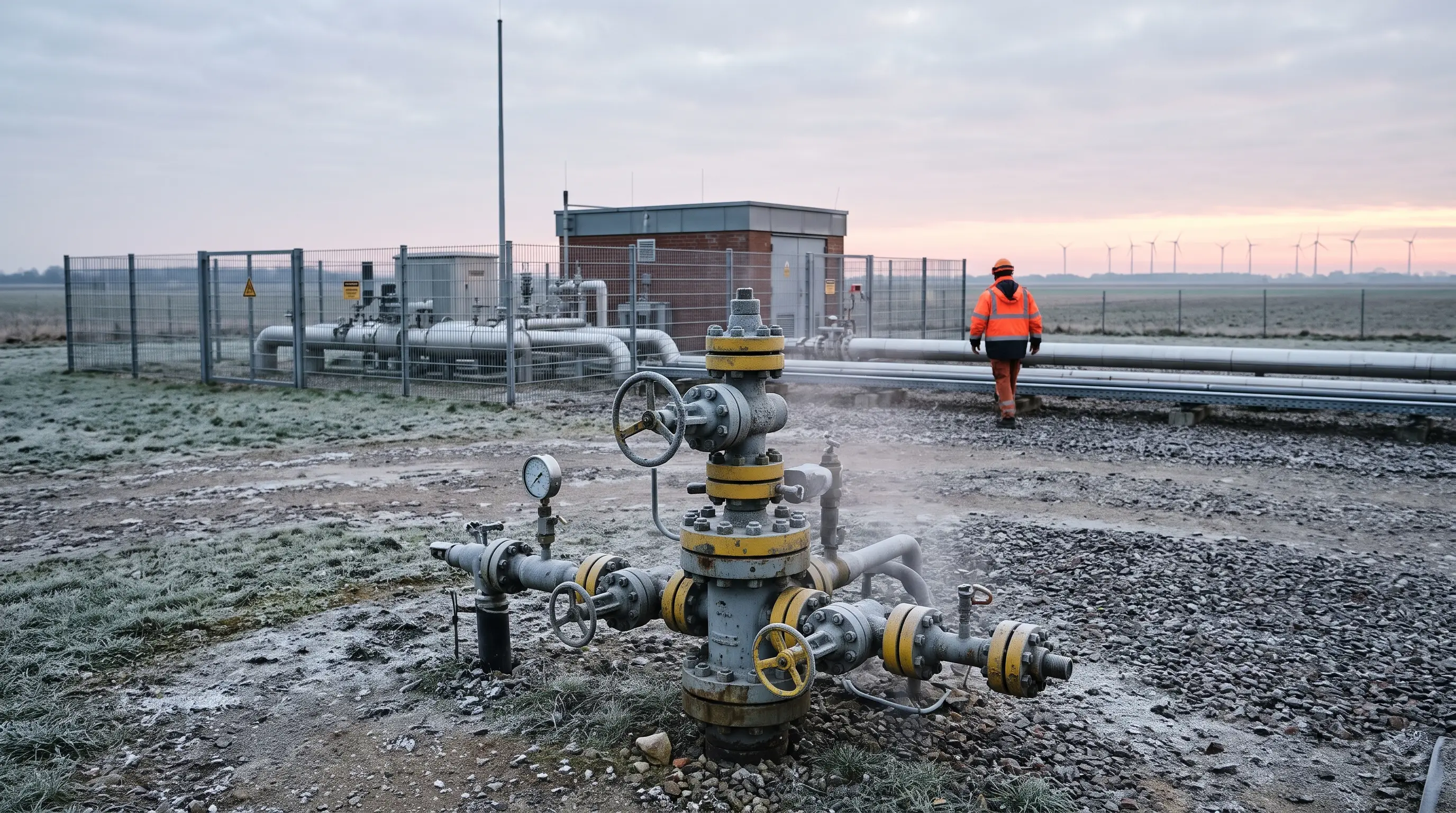
Spindletop, in Texas, lavora a 1.500 m di profondità con pressioni tra 68 e 202 bar in una caverna da 906.000 m³.
In questo articolo
Salta a una sezione
Come nasce una caverna: si scioglie la roccia, non la si scava
Perché il sale regge: poca permeabilità e creep
La finestra di pressione: tra cushion gas e fratturazione
Dall'aria compressa all'idrogeno: i siti che già lavorano
I rischi: microbi, idrogeno che reagisce, blowout
- metanogenesi, che consuma idrogeno per produrre metano;
- solfato-riduzione, che lo impiega per ridurre il solfato della salamoia;
- acetogenesi, che lo converte in acetato.
Da leggere · Energia e Reti Elettriche
Perché i cavi elettrici sottomarini usano la continua
Domande frequenti
Come funziona lo stoccaggio di idrogeno nelle caverne saline?
Perché il sale è adatto a stoccare gas e idrogeno?
Che cos'è il cushion gas e perché la caverna non si svuota del tutto?
Che differenza c'è tra duomo salino e salgemma stratificato?
L'idrogeno stoccato in caverna si perde o reagisce?
Quanto è grande una caverna salina per lo stoccaggio?
Fonti
36 riferimenti Mostra Nascondi
- pmc.ncbi.nlm.nih.gov — PMC8490397 (si apre in una nuova scheda)
«Caverns typically hold volumes of about 300,000–500,000 m3»
- observatory.clean-hydrogen.europa.eu (si apre in una nuova scheda)
«The storage plant will have a capacity of 135 GWh and will be capable to inject and withdraw 50,000 Nm³/h (approx. 4,500 kg/h) of hydrogen and to store up to 38 million Nm³ (3,420 tonnes) of hydrogen working gas volume in two salt caverns.»
- pmc.ncbi.nlm.nih.gov — PMC8490397 (si apre in una nuova scheda)
«Salt caverns provide swift deliverability of the stored energy, i.e., excellent injection and production characteristics compared with porous rocks, and have strong sealing properties on time scales relevant for gas storage»
- dx.doi.org (si apre in una nuova scheda)
«The salt cavern is located at a depth of 1500 m, with a diameter of about 70 m.»
- observatory.clean-hydrogen.europa.eu (si apre in una nuova scheda)
«The caverns will be filled with hydrogen for the first time in 2026, meaning that the hydrogen storage facility will go into commercial operation in 2027.»
- pollutionsolutions-online.com (si apre in una nuova scheda)
«During this process, water is injected into the underground salt layer to dissolve the rock salt gradually.»
- pollutionsolutions-online.com (si apre in una nuova scheda)
«When the cavern reaches the designed volume, gas is injected into the cavern to displace the residual brine.»
- pmc.ncbi.nlm.nih.gov — PMC8490397 (si apre in una nuova scheda)
«Interlayers in salt formations are difficult to dissolve in water and pose many challenges in the process of designing caverns and during their operation»
- dx.doi.org (si apre in una nuova scheda)
«three salt caverns, each with geometrical volumes of 70,000 m 3, have been in operation for about 50 years.»
- dx.doi.org (si apre in una nuova scheda)
«These salt caverns are located at an average depth of 370 m.»
- dx.doi.org (si apre in una nuova scheda)
«The salt cavern has a geometric volume of 906,000 m 3 and is operated between 68 and 202 bar.»
- pmc.ncbi.nlm.nih.gov — PMC8490397 (si apre in una nuova scheda)
«Creep is a phenomenon whereby a solid material permanently deforms with time under the influence of persistent mechanical stress.»
- comptes-rendus.academie-sciences.fr (si apre in una nuova scheda)
«when brine pressure decreases rapidly, the creep closure rate increases drastically.»
- pmc.ncbi.nlm.nih.gov — PMC8490397 (si apre in una nuova scheda)
«However, due to volumetric strain permeability of salt rocks can increase, causing the stored gases to penetrate.»
- arxiv.org — 2504.12135 (si apre in una nuova scheda)
«Thickness >200 m Stability and tightness»
- arxiv.org — 2504.12135 (si apre in una nuova scheda)
«Insoluble Minerals <25% Volume decrease and cavern shape»
- arxiv.org — 2504.12135 (si apre in una nuova scheda)
«a separation distance of 4 diameter is used for stability reasons»
- arxiv.org — 2504.12135 (si apre in una nuova scheda)
«Berest et al. [13] estimate the lifetime of a salt cavern storage to be about 60 years, after which the cavern is typically abandoned due to salt creep.»
- pollutionsolutions-online.com (si apre in una nuova scheda)
«typically, 30% of the total gas is used for cushion gas in salt caverns.»
- pollutionsolutions-online.com (si apre in una nuova scheda)
«The total gas injected into the salt caverns cannot be recovered in withdrawal cycles because a residual pressure of about 50 bar is required inside the salt cavern to strengthen it.»
- dx.doi.org (si apre in una nuova scheda)
«The salt cavern has a geometric volume of 580,000 m 3 and is operated between 70–135 bar»
- dx.doi.org (si apre in una nuova scheda)
«The cavern has a geometric volume of 566,000 m 3 and is often operated between 76 and 134 bar»
- ogst.ifpenergiesnouvelles.fr (si apre in una nuova scheda)
«During cavern operation life, maximum cavern pressure is kept signi fi cantly smaller than geostatic pressure (typically below 80%, see Sect. 5).»
- ogst.ifpenergiesnouvelles.fr (si apre in una nuova scheda)
«There exists a pressure threshold, lower than the geostatic pressure, for which micro-fracturing and an increase in salt permeability occur, vindicating the position that a safety margin is needed when selecting the maximum pressure.»
- ogst.ifpenergiesnouvelles.fr (si apre in una nuova scheda)
«in most cases, the maximum admissible gradient at the casing shoe is 0.018 MPa/m (0.8 psi/ft)»
- arxiv.org — 1709.08272 (si apre in una nuova scheda)
«The world’s first CAES plant was installed in Huntorf, Germany in 1978.»
- arxiv.org — 1709.08272 (si apre in una nuova scheda)
«The Huntorf CAES plant features two caverns with volumes of 141,000 and 169,000 m 3, respectively.»
- power-technology.com (si apre in una nuova scheda)
«The depth of the caverns is more than 600 m which ensures the stability of the air for several months’ storage, and guarantees the specified maximum pressure of 100 bar.»
- arxiv.org — 1709.08272 (si apre in una nuova scheda)
«The plant efficiencies of the Huntorf plant and McIntosh plant are ~42% and ~54%, respectively [7].»
- oa.upm.es (si apre in una nuova scheda)
«providing the large storage capacities needed to buffer seasonal energy demand»
- oa.upm.es (si apre in una nuova scheda)
«make it a suitable place for the construction of an underground storage of green hydrogen obtained from of surplus wind power»
- pollutionsolutions-online.com (si apre in una nuova scheda)
«CAPEX can be in the order of €50-100 million per cavern»
- pmc.ncbi.nlm.nih.gov — PMC11903319 (si apre in una nuova scheda)
«These caverns are not sterile, as they contain a diverse microbial world.»
- pmc.ncbi.nlm.nih.gov — PMC11903319 (si apre in una nuova scheda)
«found a high sulphate content (4.2 g/L) and low carbon content (84.9 mg/L inorganic, 7.61 mg/L organic)»
- frontiersin.org (si apre in una nuova scheda)
«Three microbial metabolisms are associated with the highest risks for implementing UHS: methanogenesis, sulfate reduction, and acetogenesis.»
- dx.doi.org (si apre in una nuova scheda)
«A blowout is not a frequent accident in gas storage caverns.»