Perché i cavi elettrici sottomarini usano la continua
Oltre 40-70 km un cavo sottomarino in alternata fa circolare potenza reattiva inaccettabile. Come la continua HVDC evita il problema e dove restano i limiti.
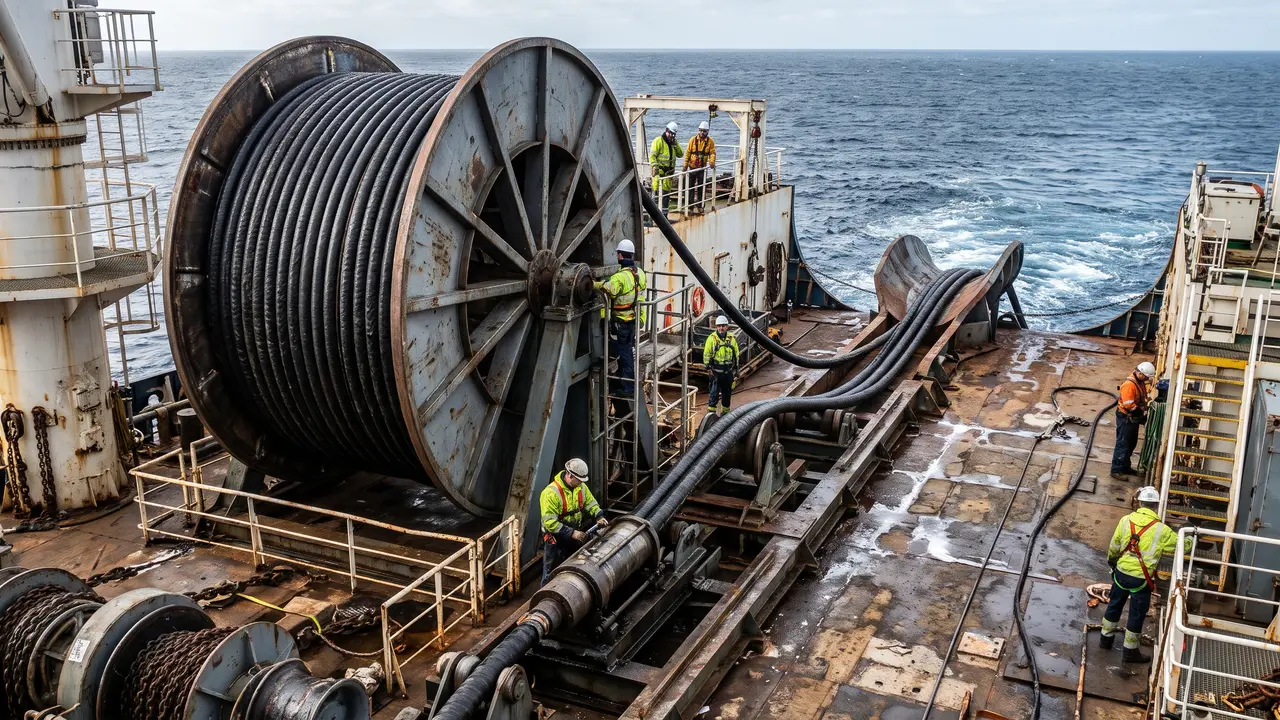
Il Tyrrhenian Link comprende due cavi sottomarini HVDC a 500 kV, per circa 970 km complessivi secondo Nexans.
In questo articolo
Salta a una sezione
Perché in mare la corrente alternata si ferma presto
40-70 km
Cosa cambia in corrente continua e cosa resta
| Voce | Alternata (AC) | Continua (HVDC) |
|---|---|---|
| Cavo sottomarino | Oltre 40-70 km la circolazione di potenza reattiva è inaccettabile[1] | La capacità si carica solo all'energizzazione o al cambio di tensione[2] |
| Potenza reattiva sul cavo | Circola lungo la linea[1] | Non generata, perché la corrente non inverte il verso[11] |
| Perdite ogni 1.000 km | 6,7%[15] | 3,5%[15] |
Le stazioni di conversione: dai tiristori ai VSC
- capacità di black start
- prestazioni dinamiche elevate
- funzioni multiterminale semplificate
- controllo indipendente di potenza attiva e reattiva
Isolamento e armatura: cosa sopporta il cavo in continua
Tyrrhenian Link e NordLink: dove lavora l'HVDC
Da leggere · Grandi Opere e Strutture
Come si costruiscono i piloni dei ponti in mare o in un fiume
Domande frequenti
Perché i cavi sottomarini HVDC usano la corrente continua?
Oltre quanti chilometri la corrente alternata non conviene più in mare?
L'HVDC elimina del tutto la potenza reattiva?
Quali perdite ha una linea HVDC rispetto all'alternata?
Il XLPE in corrente continua sopporta la stessa temperatura dell'alternata?
Quanto è profondo il cavo del Tyrrhenian Link?
Quando entra in esercizio il Tyrrhenian Link?
Fonti
45 riferimenti Mostra Nascondi
- Wiley, HVDC e FACTS (estratto) (si apre in una nuova scheda)
«for cables over 40 –70 km the reactive power circulation is unacceptable. This distance can be extended somewhat with reactive power compensation.»
- Wikipedia, High-voltage direct current (si apre in una nuova scheda)
«However, if direct current is used, the cable capacitance is charged only when the cable is first energized or if the voltage level changes; there is no additional current required.»
- Nexans, Tyrrhenian Link (si apre in una nuova scheda)
«The infrastructure consists of two 500 kV high-voltage direct current (HVDC) subsea cables, totaling approximately 970 km in length, with a transmission capacity of 1,000 MW.»
- Wikipedia, High-voltage direct current (si apre in una nuova scheda)
«The required converter stations are expensive and have limited overload capacity.»
- Wiley, HVDC e FACTS (estratto) (si apre in una nuova scheda)
«The breakeven distance is in the range of 40 –70 km for submarine cables and in the range of 600 –800 km for overhead lines.»
- ASTESJ (si apre in una nuova scheda)
«confirms that cable solutions are not feasible after 30-50km»
- MDPI Journal of Marine Science and Engineering (si apre in una nuova scheda)
«For a 100 km submarine cable transmission line, the current at the line terminal reaches 220% and 138% of the current at sending end respectively under half-load and full load conditions.»
- MDPI Journal of Marine Science and Engineering (si apre in una nuova scheda)
«the current at the end of the transmission line is far greater than its ampacity due to the large charging current, and it causes the core conductor temperature to exceed 90 °C»
- MDPI Journal of Marine Science and Engineering (si apre in una nuova scheda)
«the transmission capacity of the submarine cable is limited by the capacitive charging current.»
- Wikipedia, High-voltage direct current (si apre in una nuova scheda)
«With submarine AC cables, induction and capacitance with the surrounding sea water causes larger than normal losses, which HVDC lacks, and so HVDC submarine cables can be much longer.»
- ABB, HVDC: connecting to the future (si apre in una nuova scheda)
«In DC, as opposed to AC, electrons flow through the circuit in one direction only, and, as a result, do not generate reactive power.»
- Wikipedia, High-voltage direct current (si apre in una nuova scheda)
«A major drawback of HVDC systems using line-commutated converters is that the converters inherently consume reactive power.»
- Wiley, HVDC e FACTS (estratto) (si apre in una nuova scheda)
«The converters typically require reactive power of around 60% of the converter power rating.»
- Wikipedia, High-voltage direct current (si apre in una nuova scheda)
«VSCs, on the other hand, can either produce or consume reactive power on demand, with the result that usually no separate shunt capacitors are needed»
- Wikipedia, High-voltage direct current (si apre in una nuova scheda)
«Depending on voltage level and construction details, HVDC transmission losses are quoted at 3.5% per 1,000 km (620 mi), about 50% less than AC (6.7%) lines at the same voltage.»
- Wikipedia, High-voltage direct current (si apre in una nuova scheda)
«Since 1977, new HVDC systems have used solid-state devices, in most cases thyristors.»
- T&D World, A short history: the voltage source converter (si apre in una nuova scheda)
«In 1997, the first experimental voltage source converter (VSC) HVDC system was tested in Hellisjon, Sweden.»
- T&D World, A short history: the voltage source converter (si apre in una nuova scheda)
«It was a 50-MW, ±80-kV submarine cable connection on the island of Gotland in Sweden.»
- T&D World, A short history: the voltage source converter (si apre in una nuova scheda)
«In the 1990s they borrowed an idea from the DC drives industry, the insulated-gate bipolar transistor (IGBT).»
- T&D World, A short history: the voltage source converter (si apre in una nuova scheda)
«This offers several unique features such as black-start capability, high dynamic performance, simplified multi-terminal capabilities, and independent control of both active and reactive power.»
- Wikipedia, High-voltage direct current (si apre in una nuova scheda)
«With the recently developed MMCs, levels of harmonic distortion may be practically negligible»
- ABB, HVDC: connecting to the future (si apre in una nuova scheda)
«Thanks to the superior reactive power control capability of an HVDC Light terminal, it can increase the transfer capacity of the AC network surrounding the terminal.»
- MDPI Energies, cavi HVDC estrusi (si apre in una nuova scheda)
«This involves lower maximum permissible temperature of the insulation in continuous operation for DC-XLPE vs. AC-XLPE (70 °C vs. 90 °C)»
- MDPI Energies, cavi HVDC estrusi (si apre in una nuova scheda)
«HVDC extruded cable insulation is particularly sensitive to trapped space charge»
- MDPI Energies, cavi HVDC estrusi (si apre in una nuova scheda)
«much longer degassing times vs. AC-XLPE to hamper space-charge storage under DC voltage due to cross-linking byproducts.»
- Jicable 2023, cavi HVDC a 525 kV (si apre in una nuova scheda)
«due to the lack of experience of power transmission with HVDC cables of voltages above 400 kV»
- Jicable 2023, cavi HVDC a 525 kV (si apre in una nuova scheda)
«The test is successfully carried out according to CIGRE TB 496»
- Jicable 2023, cavi HVDC a 525 kV (si apre in una nuova scheda)
«subsea cable and underground cable with a maximum DC voltage of 550 kV and a rated current up to 2000 A»
- Prysmian, scheda del cavo sottomarino XLPE 525 kV (si apre in una nuova scheda)
«The insulated core has a lead alloy sheath applied over the longitudinal water barrier.»
- Prysmian, scheda del cavo sottomarino XLPE 525 kV (si apre in una nuova scheda)
«Single or double layer of galvanized steel round wires, flushed with bitumen as further anti-corrosion protection.»
- ABB, HVDC: connecting to the future (si apre in una nuova scheda)
«Typically, a link will have two cables, with one carrying voltage of positive polarity and the other negative.»
- T&D World, ramo ovest del Tyrrhenian Link (si apre in una nuova scheda)
«Work was completed off the Sardinian coast at Quartu Sant'Elena (CA) on board the Aurora, a ship belonging to Nexans»
- Nexans, Tyrrhenian Link (si apre in una nuova scheda)
«will set a world record for the greatest installation depth of a high-voltage (HVDC) subsea cable, reaching 2,150 meters below sea level»
- Il Sole 24 Ore, ramo est del Tyrrhenian Link (si apre in una nuova scheda)
«The eastern section of the Tyrrhenian Link is the longest submarine link ever built by Terna, with approximately 490 km of direct current cable at a maximum depth of 1,560 metres.»
- Il Sole 24 Ore, ramo est del Tyrrhenian Link (si apre in una nuova scheda)
«The laying, which was carried out with Prysmian's Leonardo Da Vinci, took place in two phases»
- Affaritaliani, Terna completa la posa del ramo est (si apre in una nuova scheda)
«con una capacità di trasmissione di 1.000 MW per tratta e la piena entrata in esercizio attesa per il 2028»
- Hitachi Energy, NordLink (si apre in una nuova scheda)
«NordLink is not only the world’s longest VSC cable connector at 623 km»
- Hitachi Energy, NordLink (si apre in una nuova scheda)
«NordLink is the world’s first HVDC Light® bi-pole installation to perform at a record level of 525-kilovolt (kV) and 1,400 megawatt (MW)»
- Wikipedia, High-voltage direct current (si apre in una nuova scheda)
«Italy's 420 km (260 mi) SAPEI cable between Sardinia and the mainland»
- T&D World, ramo ovest del Tyrrhenian Link (si apre in una nuova scheda)
«Around 480 km of submarine cables have been installed, stretching from Fiumetorto in the municipality of Termini Imerese (PA) to Terra Mala (CA) in three months.»
- Nexans, Tyrrhenian Link (si apre in una nuova scheda)
«Terna will invest a total of approximately €3.7 billion in the project»
- ABB, HVDC: connecting to the future (si apre in una nuova scheda)
«Mass-impregnated cables have been in use since 1895.»
- ABB, HVDC: connecting to the future (si apre in una nuova scheda)
«HVDC Light, introduced by ABB in 1997»
- Jicable 2003, cavi HVDC in XLPE (si apre in una nuova scheda)
«A yearlong performance test (long-term test) carried through on the DC XLPE cable system, which resulted in no breakdown.»
- MDPI Energies, cavi HVDC estrusi (si apre in una nuova scheda)
«the German Transmission System Operators (TSOs) are realizing new 525 kV/2000 A-DC extruded cable links connecting offshore wind RES in the North Sea to industrial areas in South Germany.»