Il millimetro che ha ucciso la porta USB-A sui portatili
Perché la porta USB-A è sparita dai PC? Dai 4,5 mm di spessore e 4 pin del 1996 ai 24 contatti di USB-C con 240 W di ricarica e video DisplayPort a 80 Gbps.
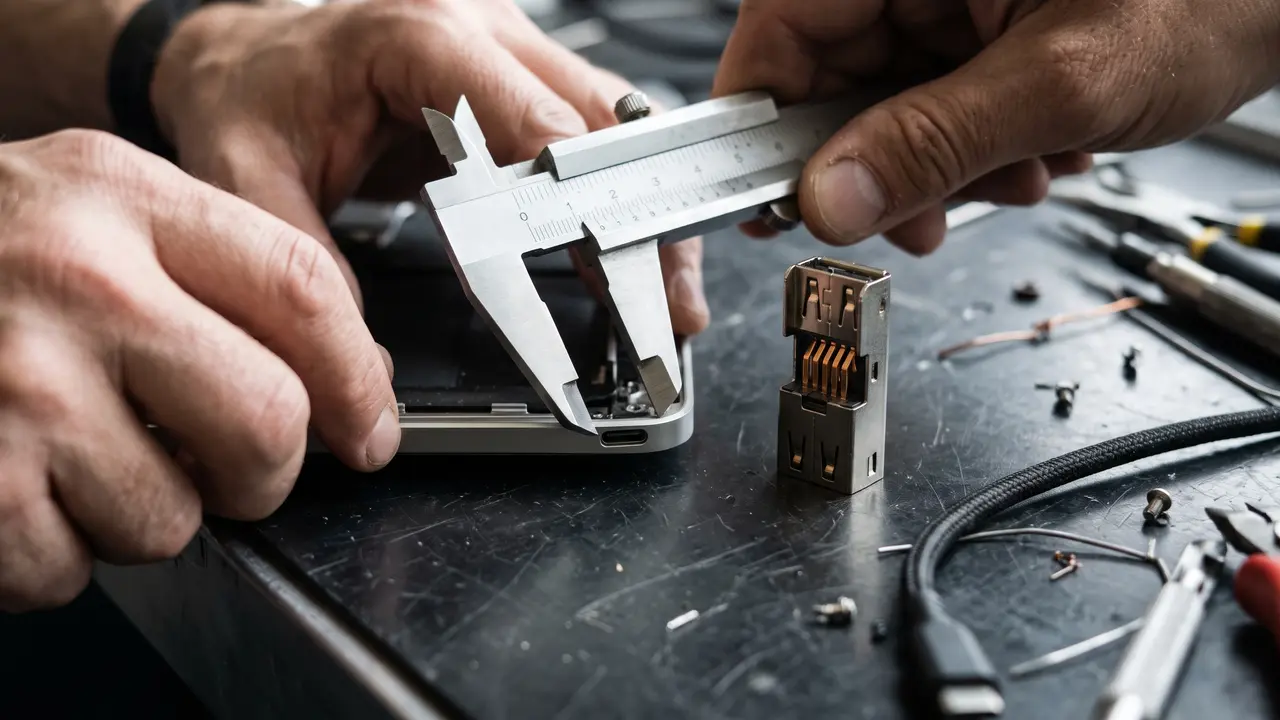
La spina USB Standard-A è alta 4,5 mm, mentre il connettore USB Type-C misura appena 2,4 mm di spessore.
- Spessore delle due spine
- 4,5 vs 2,4 mm
- Altezza della spina USB Standard-A contro quella del connettore USB Type-C[1]
- Contatti su doppia fila
- 24 pin
- Pin a simmetria rotazionale in un ricettacolo USB-C da 8,34 × 2,56 mm[2]
- Potenza massima su cavo
- 240 W
- Alimentazione EPR (48 V a 5 A) introdotta con USB Power Delivery 3.1 nel 2021[4]
In questo articolo
Salta a una sezione
Il limite del millimetro: ingombro fisico e compromesso economico del 1996
| Parametro tecnico | USB Standard-A | USB Type-C |
|---|---|---|
| Geometria e dimensioni | Spina 12 × 4,5 mm (non reversibile)[1] | Ricettacolo 8,34 × 2,56 × 6,20 mm (reversibile)[2] |
| Vita meccanica minima | 1.500 cicli di inserimento[6] | 10.000 cicli di inserimento[6] |
| Potenza massima erogabile | 2,5 W (USB 2.0) / 4,5 W (USB 3.1)[7] | 15 W nativi / 100 W (PD 3.0) / 240 W (PD 3.1)[4][7] |
Da 4 a 24 pin: perché la reversibilità ad alta velocità richiede un multiplexer
- Quattro pin di alimentazione (VBUS) dedicati al trasferimento dell'energia elettrica.[8]
- Quattro pin di riferimento a massa (GND) distribuiti agli estremi del pettine.[8]
- Due coppie differenziali centrali per i dati legacy USB 1 (1,5 e 12 Mbit/s half-duplex) e USB 2 (480 Mbit/s half-duplex), collegate insieme lato dispositivo.[8]
- Quattro coppie differenziali schermate per il traffico Enhanced SuperSpeed, ripartite in due coppie di trasmissione e due di ricezione.[8]
- Due pin Sideband Use (SBU) riservati ai canali ausiliari dei protocolli alternativi.[8]
- Due pin Configuration Channel (CC) incaricati di rilevare l'attacco del cavo e negoziare ruoli e tensioni.[8]
Il problema dello stub sulle linee SuperSpeed e il ruolo dei pin CC
Multiplexing dei protocolli: 80 Gbps di video DisplayPort e 4 corsie PCI Express
77,37 Gbps
Da DisplayPort 2.0 a Thunderbolt 3: un solo cavo per video ed eGPU
Dai 2,5 W all'Extended Power Range da 240 W: la fine degli alimentatori proprietari

Da leggere · Computing e IA
Cosa blocca i governi che abbandonano Windows e Office per Linux
Dal mercato alla legge: l'obbligo europeo del caricabatterie unico per i portatili
Non tutti i cavi USB-C trasportano video o 240 W
Domande frequenti
Perché la porta USB-A è sparita dai PC portatili moderni?
Qual è la differenza di spessore fisico tra una porta USB-A e una USB-C?
Quanti pin ci sono dentro un connettore USB-C e a cosa servono?
Perché il vecchio connettore USB-A non era reversibile fin dall'inizio?
Come fa una porta USB-C a trasmettere video DisplayPort a un monitor 8K?
Quanta potenza di ricarica può erogare una porta USB-C rispetto alla USB-A?
Quando scatta l'obbligo europeo della porta USB-C anche per i computer portatili?
Fonti
24 riferimenti Mostra Nascondi
- Wikipedia — USB hardware (si apre in una nuova scheda)
«Standard‑A connectors: This plug has an elongated rectangular cross-section, inserts into a Standard‑A receptacle on a downstream facing port (DFP) on a USB host or hub, and carries both power and data.[26][27] The plug itself is 12 mm wide and 4.5 mm thick.»
- Wikipedia — USB-C (si apre in una nuova scheda)
«The 24-pin double-sided connector is slightly larger than the non-SuperSpeed, USB 2.0 Micro connectors, with a USB‑C receptacle opening measuring 8.34 mm × 2.56 mm, 6.20 mm deep.»
- NPR, 21 Jun 2019 (si apre in una nuova scheda)
«A USB that could plug in correctly both ways would have required double the wires and circuits, which would have then doubled the cost. The Intel team led by Bhatt anticipated the user frustration and opted for a rectangular design and a 50-50 chance to plug it in correctly, versus a round connector with less room for error.»
- USB Implementers Forum — USB Charger (USB Power Delivery) (si apre in una nuova scheda)
«Announced in 2021, the USB PD Revision 3.1 specification is a major update to enable delivering up to 240W of power over full featured USB Type-C® cable and connector. Prior to this update, USB PD was limited to 100W using a solution based on 20V using USB Type-C cables rated at 5A.»
- NPR, 21 Jun 2019 (si apre in una nuova scheda)
«Yet, instead of simply springing for the extra costs, Bhatt's team at Intel strategically chose to keep it cheap. The success of their project hinged on a Herculean task: persuading all the major computer companies to adopt the USB model.»
- Wikipedia — USB hardware (si apre in una nuova scheda)
«Standard USB connectors have a minimum rated lifetime of 1,500 cycles of insertion and removal,[10] and this increased to 5,000 cycles for Mini-B connectors.[10] The rating for all Micro connectors is 10,000 cycles,[10] and the same applies to USB-C.[11]»
- Texas Instruments — A Primer on USB Type-C and USB Power Delivery Applications and Requirements (SLYY109B) (si apre in una nuova scheda)
«Without USB PD, you can support up to 5 V at 3 A (15 W) with just USB Type-C alone. However, with USB PD, you can support up to 20 V at 5 A (100 W) within the USB Type-C ecosystem.»
- Wikipedia — USB-C (si apre in una nuova scheda)
«The receptacle features four power and four ground pins, two differential pairs (connected together on devices) for legacy USB 1 (1.5 and 12 Mbit/s half-duplex) and 2 (480 Mbit/s half-duplex) data, four shielded differential pairs for Enhanced SuperSpeed data (two transmit and two receive pairs), two Sideband Use (SBU) pins, and two Configuration Channel (CC) pins.»
- Texas Instruments — SLYY109B (si apre in una nuova scheda)
«Unlike the D+/D– lines, you cannot simply short the common lines together, because that will create a stub. At USB 2.0 speeds, a stub is acceptable, but at USB 3.1 speeds, a stub degrades signal integrity too much.»
- Texas Instruments — SLYY109B (si apre in una nuova scheda)
«Cable orientation is based on which CC line pulls down (if CC1 pulls down, the cable is not flipped; but if CC2 pulls down, the cable is flipped). For nonactive cables, the remaining CC line remains open; for active cables, the remaining CC line will pull down with Ra.»
- Texas Instruments — SLYY109B (si apre in una nuova scheda)
«VCONN can power passive electronically marked or active cables (cables that support USB PD communication and provide a method for determining cable characteristics ) by switching 5 V onto the unused CC line (see the appendix).»
- Texas Instruments — SLYY109B (si apre in una nuova scheda)
«When no device is attached, VBUS should sit at 0 V. The USB Type-C specification requires a source to discharge VBUS within 650 ms of a detached sink [1].»
- VESA — DisplayPort Alternate Mode on USB Type-C (si apre in una nuova scheda)
«The DisplayPort Alt Mode repurposes some or all of the four existing SuperSpeed USB lanes to deliver full DisplayPort performance, and uses other signaling available in the USB Type-C connector for DisplayPort’s AUX channel and HPD (Hot Plug Detection) function.»
- VESA — DisplayPort Alternate Mode on USB Type-C (si apre in una nuova scheda)
«Like USB, DisplayPort uses a packetized data structure and differential AC-Coupled signal “lanes” that carry high speed data with an embedded clock. This allows the same electrical circuits and cables to carry either SuperSpeed USB data, at up to 10 Gbps per lane, or DisplayPort, at up to 8.1 Gbps per lane, as defined in the new DisplayPort 1.3 Standard.»
- VESA — DisplayPort Alternate Mode on USB Type-C (si apre in una nuova scheda)
«By leveraging USB Type-C’s flexibility, the DisplayPort Alt Mode can choose to transmit on just one or two of the four available lanes, so that the other two lanes can be used for SuperSpeed USB data at the same time.»
- VESA — DisplayPort Alt Mode 2.0 Specification (si apre in una nuova scheda)
«With DisplayPort Alt Mode, the USB-C connector can transmit up to 80 Gigabits per second (Gbps) of DisplayPort video data utilizing all four high-speed lanes in the cable, or up to 40 Gbps with simultaneous SuperSpeed USB data delivery.»
- VESA — DisplayPort Alt Mode 2.0 Specification (si apre in una nuova scheda)
«Featuring the highly efficient 128b/132b channel coding shared with USB4, DisplayPort 2.0 delivers a maximum payload of 77.37 Gbps across four lanes (up to 19.34 Gbps per lane)—supporting ultra-high display performance configurations such as an 8K (7680×4320) display with 60 Hz refresh rate with full-color 30 bpp 4:4:4 HDR resolution uncompressed, and 16K (15360×8640) 60 Hz display with 30 bpp 4:4:4 HDR resolution with compression.»
- Intel / Thunderbolt Technology — Thunderbolt 3: The USB-C That Does It All (si apre in una nuova scheda)
«Bi-directional, dual-protocol (PCI Express and DisplayPort) 4 lanes of PCI Express Gen 3 8 lanes of DisplayPort 1.2 (HBR2 and MST) Supports two 4K displays (4096 x 2160 30bpp @ 60 Hz)»
- Texas Instruments — SLYY109B (si apre in una nuova scheda)
«Even if USB PD power levels are not required, you must include a USB PD PHY and USB PD manager to support Alternate Mode because it is negotiated the same way as USB PD – a vendor-defined message over the CC line.»
- USB Promoter Group — USB Power Delivery 3.1 Announcement, 26 May 2021 (si apre in una nuova scheda)
«A choice of three new fixed voltages: 28V (above 100W), 36V (above 140W) and 48V (above 180W) joining previously defined 5V, 9V, 15V and 20V fixed voltages.»
- USB Promoter Group — USB Power Delivery 3.1 Announcement, 26 May 2021 (si apre in una nuova scheda)
«“With the new capabilities of USB Power Delivery 3.1, we now enable higher power products such as larger notebook PCs to shift from traditional power connectors to USB Type-C,” said Brad Saunders, USB Promoter Group Chairman.»
- USB Implementers Forum — USB Charger (USB Power Delivery) (si apre in una nuova scheda)
«Power direction is no longer fixed. This enables the product with the power (Host or Peripheral) to provide the power.»
- European Commission — EU common charger rules, 28 Dec 2024 (si apre in una nuova scheda)
«From 28 December 2024, the rules apply to mobile phones, tablets, digital cameras, headphones, headsets, videogame consoles, portable speakers, e-readers, keyboards, mice, portable navigation systems and earbuds sold in the EU. From 28 April 2026, they will also apply to laptops.»
- USB Implementers Forum — Marketing Name Guidance, Jan 2023 (si apre in una nuova scheda)
«USB-C® to USB-C® Cables • USB 80Gbps / [60W / 240W] • USB 40Gbps / [60W / 240W] • USB 20Gbps / [60W / 240W] • USB 5Gbps / [60W / 240W] • Hi-Speed USB / [60W / 240W]»