Come viaggiano i treni a 300 km/h con ERTMS e senza semafori
A 300 km/h servono 7.513 metri per fermare un treno: ecco come funziona ERTMS/ETCS Livello 2 tra boe Eurobalise a 27 MHz, radio GSM-R e curve di frenatura EBI.
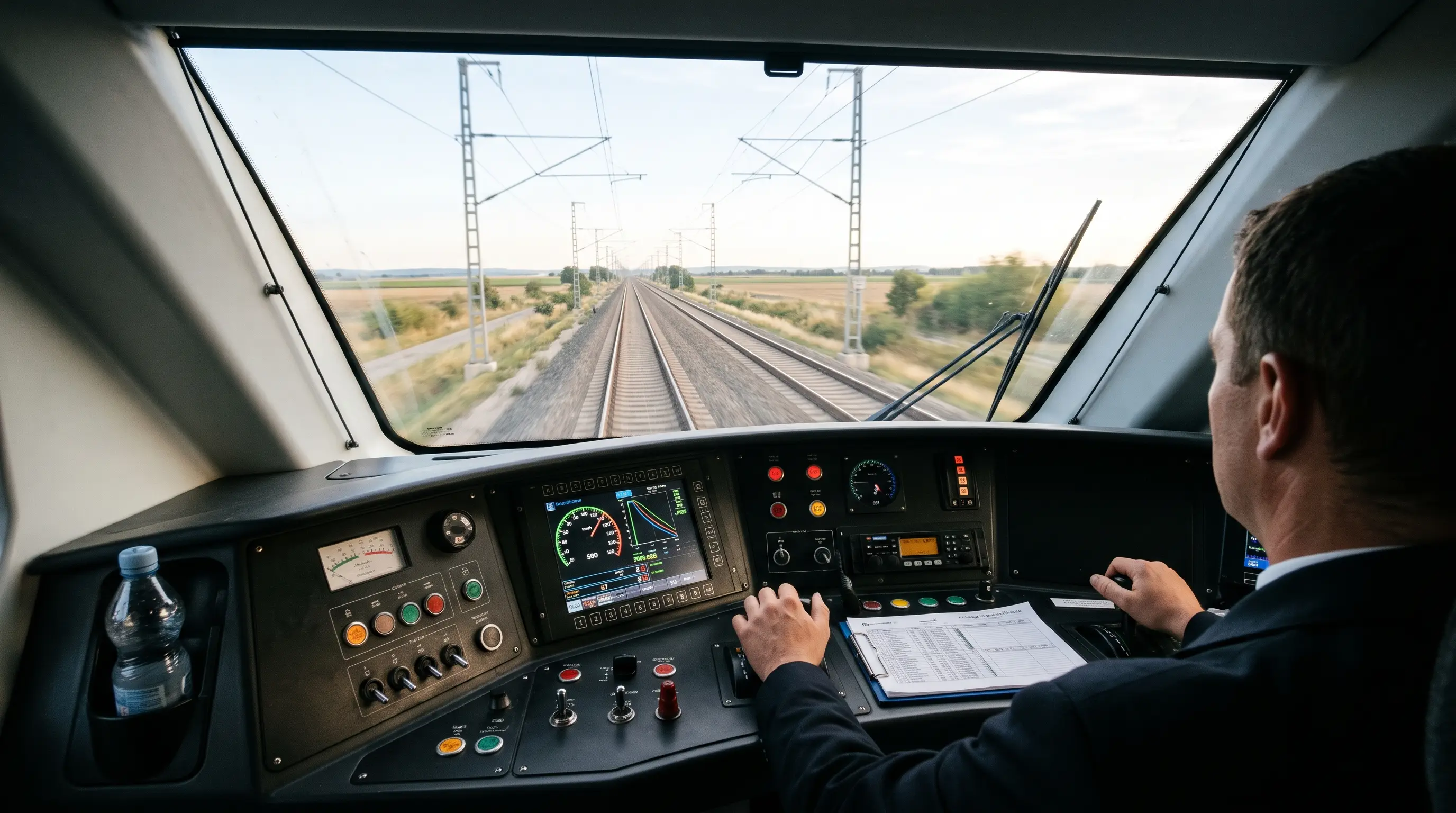
A 300 km/h un treno percorre 83,3 metri al secondo e per fermarsi in sicurezza richiede fino a 7.513 metri di supervisione.
- Spazio totale di frenatura
- 7.513 m
- Distanza calcolata da 300 km/h su discesa del 10‰ fino all'arresto sulla curva EBD[1]
- Velocità dati Eurobalise
- 564,48 kbit/s
- Flusso uplink a 4,234 MHz capace di inviare tre copie del telegramma fino a 500 km/h[5]
- Rete AV italiana senza fari
- 1.071 km
- Linee ad alta velocità attrezzate con il solo ERTMS Livello 2 senza segnali laterali[2]
In questo articolo
Salta a una sezione
Il limite ottico dei 300 km/h: perché l'acciaio su acciaio impone il segnalamento in cabina
362 km/h
Architettura dell'ERTMS/ETCS Livello 2: dal Radio Block Centre al cruscotto DMI
| Configurazione | Segnali luminosi a terra | Trasmissione autorizzazioni (MA) | Rilevamento occupazione binario |
|---|---|---|---|
| Segnalamento ottico tradizionale | Necessari (avviso e prima categoria) | Visiva tramite l'aspetto dei fari | Circuiti di binario o contassi a terra |
| ETCS Livello 2 convenzionale | Assenti (solo tabelle rifrangenti) | Continua via radio GSM-R / FRMCS da RBC | Sezioni fisse a terra (es. 1.800 m in Italia) |
| ETCS Livello 2 con blocco mobile (CCS TSI 2023) | Assenti | Continua via radio da RBC su cruscotto DMI | Integrità e posizione verificate a bordo treno |
Dentro le boe gialle Eurobalise: telealimentazione a 27 MHz e pietre miliari digitali
- Telealimentazione induttiva a 27,095 MHz: l'antenna del modulo BTM (Balise Transmission Module), montata sotto la cassa del treno a 21 centimetri sopra il piano del ferro, irradia un campo magnetico a onda continua da 65 watt che accende per induzione la bobina interna della boa, esattamente come il secondario di un trasformatore.[5][14]
- Uplink in modulazione FSK a 4,234 MHz: appena energizzata, la Eurobalise risponde verso il treno modulando in frequenza un campo magnetico centrato a 4,234 MHz, usando i 3,951 MHz per lo zero logico e i 4,516 MHz per l'uno logico.[14]
- Telegramma ridondante a 564,48 kbit/s: il trasponder spara a raffica un pacchetto codificato da 1.023 bit (830 bit di dati utili) oppure da 341 bit (210 bit utili), con codifica a 11 bit per simbolo e 85 bit di checksum; la velocità di trasmissione basta a consegnare almeno tre copie complete del telegramma a un treno che sfreccia a 500 km/h.[5][15]
La matematica della frenatura: 7.513 metri di calcolo e cinque curve di sicurezza
Da leggere · Trasporti e Macchine
Perché i treni merci lunghi chilometri frenano con un tubo d'aria
Treni Gamma, metodo Monte Carlo e margini su rotaia bagnata
Da Indication a EBI: la scaletta che scavalca il macchinista
- Indication (I): la prima soglia che avvisa il macchinista di iniziare a frenare; a 300 km/h scatta a 7.513 metri dal punto di arresto, concedendo 9 secondi (750 metri percorsi) prima del limite successivo.[1][19]
- Permitted speed (P): la curva della velocità massima ammessa istante per istante sul tachimetro circolare del DMI.[19]
- Warning (W): la soglia oltre la quale la cabina emette un allarme acustico e visivo per segnalare il supero della velocità permessa.[19]
- Service Brake Intervention (SBI): il primo intervento automatico con il solo freno di servizio, calibrato per rallentare il convoglio senza sottoporre ruote, dischi e binari allo stress termico e meccanico della frenata d'emergenza.[19]
- Emergency Brake Intervention (EBI): il «paracadute» finale dell'ETCS, posto a 4 secondi (333 metri) oltre la curva P; superato questo punto il computer scavalca l'uomo al comando, taglia la trazione e scarica tutta la potenza frenante d'emergenza.[1][17]
Cosa succede se cade il segnale radio: il timer T_NVCONTACT e il passaggio al 5G ferroviario
Perdita radio non significa frenata istantanea
Domande frequenti
Come funziona l'ERTMS sull'alta velocità, senza semafori lungo i binari?
Perché a 300 km/h i semafori ferroviari tradizionali non bastano più?
Come fanno le boe gialle Eurobalise a funzionare senza batteria né cavi?
Qual è la differenza tra i limiti di frenatura SBI ed EBI nell'ETCS?
Cosa succede se un treno ad alta velocità perde il segnale radio in galleria?
Quando verrà sostituito il GSM-R con il nuovo sistema FRMCS?
Fonti
24 riferimenti Mostra Nascondi
- European Union Agency for Railways (ERA) — Introduction to ETCS braking curves (si apre in una nuova scheda)
«Total distance: 7513 m Line speed = 300 km/h»
- UNIFE / ERTMS — Italy Factsheet ERTMS Deployment (si apre in una nuova scheda)
«As of 31 December 2022, 1.071 km of High-Speed network have been equipped with ERTMS without overlapping the national signalling systems and without lateral signal lights.»
- UNIFE / ERTMS — ERTMS/ETCS Levels Factsheet (2024) (si apre in una nuova scheda)
«ERTMS/ETCS Level 2 is a radio-based signalling system that displays signalling and movement authorities in the cab, eliminating the need for lineside signals. Movement authority is communicated directly from a Radio Block Centre (RBC) to the on-board unit via GSM-R/ FRMCS radio.»
- UNISIG / ERA — SUBSET-093 GSM-R Interfaces Class 1 Requirements (si apre in una nuova scheda)
«The end-to-end transfer delay of a user data block of 30 bytes shall be ≤0.5s (99%).»
- Wikipedia — Eurobalise (UNISIG SUBSET-036) (si apre in una nuova scheda)
«The data rate of 564.48 kbit/s is enough to transmit three copies of a telegram to a train passing at 500 km/h.»
- European Union Agency for Railways (ERA) — Introduction to ETCS braking curves (si apre in una nuova scheda)
«Braking a train is more demanding than braking a road vehicle: the low wheel-rail grip which makes rail transport so energy efficient also makes for longer braking distances. For instance, a high speed passenger train requires several kilometres to brake to standstill.»
- European Union Agency for Railways (ERA) — Introduction to ETCS braking curves (si apre in una nuova scheda)
«In a few words, driving with optical signals implies that the location where to start braking is fixed, while the initial speed is adapted in order to match the braking performance of the train. With ETCS, this is exactly the contrary: the initial speed is constant, while the location where to start braking is adapted according to the braking performance of the train.»
- UNIFE / ERTMS — Italy Factsheet ERTMS Deployment (si apre in una nuova scheda)
«In most sections of it, ERTMS level 2 is the sole signalling system - without any fall-back system and without trackside signals – resulting in considerable savings in infrastructure and maintenance costs.»
- UNIFE / ERTMS — Italy Factsheet ERTMS Deployment (si apre in una nuova scheda)
«A notable example is the Bologna-Florence route, where 73 km of the 80 km line traverse tunnels. During test runs, a world speed record in a tunnel was achieved at 362 km/h.»
- UNIFE / ERTMS — ETCS vs Positive Train Control (PTC) (si apre in una nuova scheda)
«ETCS relies on the precise position of the train, with the trackside system issuing a Movement Authority (MA), the formal authorization that defines how far and under what conditions a train may proceed, based on a path permitted and continuously monitored by an interlocking.»
- Wikipedia — European Rail Traffic Management System (si apre in una nuova scheda)
«Il percorso è privo di segnali luminosi del tipo tradizionale a terra (ad eccezione dei segnali di confine) e di blocco elettrico a correnti codificate, ed al suo posto è stato attivato un sistema di blocco radio che assicura il controllo dei treni mediante un continuum di informazioni scambiate tra i treni e un posto centrale RBC mediante boe "Eurobalise" e GSM-R.»
- Wikipedia — European Rail Traffic Management System (si apre in una nuova scheda)
«Le sezioni di blocco sono di lunghezza fissa di 1800m, sono individuate da apposite boe e segnalate mediante una segnaletica rifrangente di inizio e fine sezione.»
- UNIFE / ERTMS — ERTMS/ETCS Levels Factsheet (2024) (si apre in una nuova scheda)
«ERTMS/ETCS Level 3 has been merged into ERTMS/ETCS Level 2 with the CCS TSI 2023. Therefore, it is no longer a differentiator for specific functionalities, like fixed virtual block/moving block, with assurance of train integrity and location within the ERTMS/ETCS solution.»
- Wikipedia — Eurobalise (UNISIG SUBSET-036) (si apre in una nuova scheda)
«In response to "telepowering" by means of a 27 MHz, CW-modulated magnetic field transmitted by a Balise Transmission Module [de] (BTM and its associated antenna) mounted under a passing train, the balise transmits information to the train (uplink) by means of a 4.234 MHz FSK-modulated magnetic field.»
- Wikipedia — Eurobalise (UNISIG SUBSET-036) (si apre in una nuova scheda)
«A balise transmits a 'telegram' of either 1023 bits (93*11) or 341 bits (31*11) in the channel encoding with 11 bit per symbol. The user data block is cut into 10-bit user symbols before the scrambling and shaping operation - the effective payload of signalling information is 830 bit (83*10) for the long telegram and 210 bit (21*10) for the short telegram.»
- Wikipedia — Eurobalise (UNISIG SUBSET-036) (si apre in una nuova scheda)
«Linked balises may send data (the "link list") to the trainborne equipment containing the identity of and distance to the following balise group or groups. By this means, the trainborne equipment is able to determine where to expect a balise and thus to identify if a balise has failed.»
- European Union Agency for Railways (ERA) — Introduction to ETCS braking curves (si apre in una nuova scheda)
«This distance determines a location called the EBI (Emergency Brake Intervention) supervision limit, i.e. the point beyond which ETCS will bypass the human in charge (see Figure 1 ). The EBD curve and the resulting EBI supervision limit are the elements of the ETCS speed and distance monitoring function, which materialize the so-called ETCS parachute.»
- European Union Agency for Railways (ERA) — Introduction to ETCS braking curves (si apre in una nuova scheda)
«When the ETCS on-board equipment is fitting a train with a fixed composition or a finite number of predefined compositions, all the nominal deceleration profiles, their corresponding rolling stock correction factors and the brake build up times can be preconfigured in the ETCS on-board equipment (see Figure 6 ). The trains for which it is possible to store such predefined data are called “Gamma trains”.»
- European Union Agency for Railways (ERA) — Introduction to ETCS braking curves (si apre in una nuova scheda)
«Therefore the ETCS on-board calculates in real time other supervision limits: Indication (I), Permitted speed (P), Warning (W) and Service Brake Intervention (SBI) (only if the ETCS on-board is designed to command itself the service brake).»
- UNISIG / ERA — SUBSET-093 GSM-R Interfaces Class 1 Requirements (si apre in una nuova scheda)
«Train speed : 360 km/h ; radio cells : 2 km; cell hand over every 20 seconds»
- UNISIG / ERA — SUBSET-093 GSM-R Interfaces Class 1 Requirements (si apre in una nuova scheda)
«The time without ETCS supervision caused by the re-establishment of the safe connection after connection loss is at least 27s.»
- Rete Ferroviaria Italiana (RFI) — Piano investimenti ERTMS 2036 (si apre in una nuova scheda)
«Il tutto con un risparmio previsto in termini economici di quattro miliardi di euro in minori costi e una riduzione del consumo energetico di almeno il 15% per le imprese ferroviarie.»
- Rete Ferroviaria Italiana (RFI) — Direttissima Roma-Firenze ERTMS (si apre in una nuova scheda)
«Previsto un investimento di 147 milioni di euro di cui 142 per la nuova tecnologia ERTMS nella tratta Orvieto-Settebagni e 5 milioni di euro per la manutenzione straordinaria delle opere civili sul viadotto Paglia e nella Galleria Fabro.»
- European Union Agency for Railways (ERA) — Future Railway Mobile Communication System (FRMCS) (si apre in una nuova scheda)
«The involved suppliers have indicated that they will support GSM-R technology and GSM-R products at least until 2030. Taking into account the time needed to deploy another radio system and to mitigate the risk of GSM-R obsolescence, the Agency has launched a project to investigate the options for a smooth transition from GSM-R to a next generation system.»