Grande Muraglia Verde nel Sahel: perché gli alberi non bastano
Perché l'80% delle piantine nella Grande Muraglia Verde del Sahel moriva e come bacini a mezza luna, buche zaï e aratri Delfino spezzano la crosta del suolo.
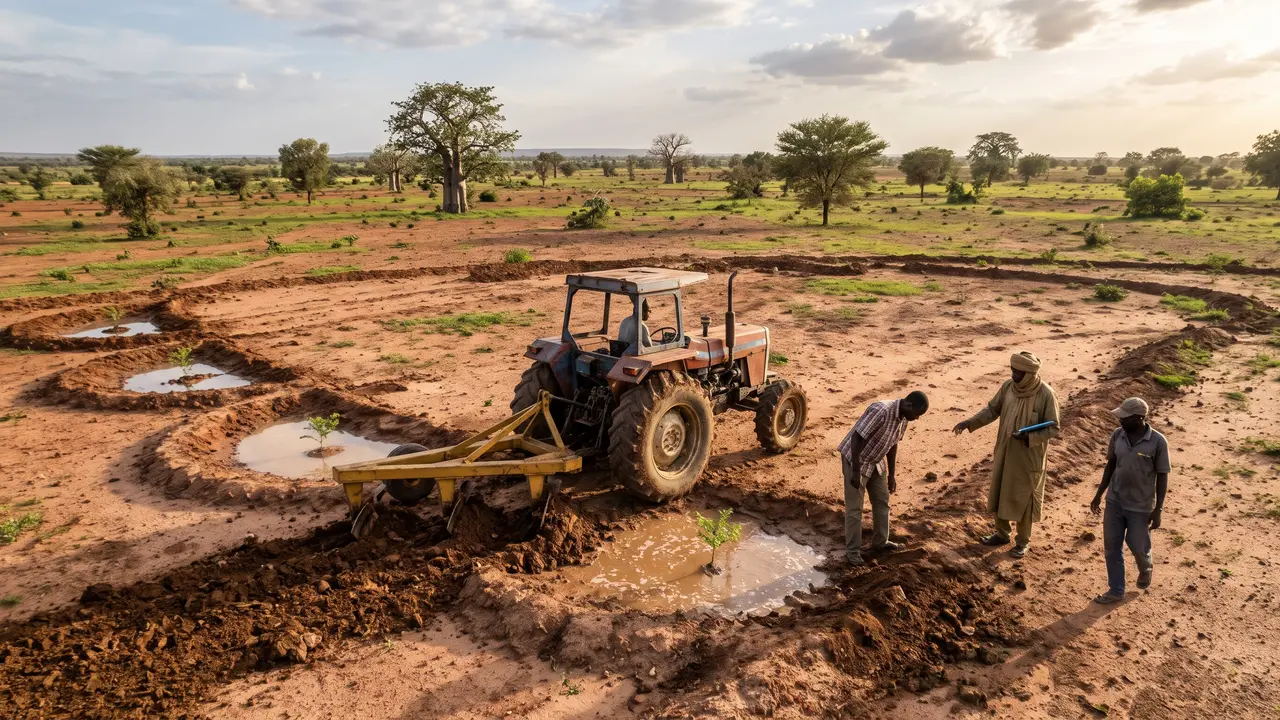
Fin dagli anni Ottanta nei programmi di piantagione del Sahel è morto l'80% o più degli alberi, secondo Chris Reij.
- Mortalità alberi piantati
- 80%+
- Quota di piantine morte nei vecchi programmi di rimboschimento nel Sahel[2]
- Acqua per ogni mezza luna
- 1.000 litri
- Capacità di ritenzione idrica dei bacini scavati dall'aratro Delfino FAO[3]
- Alberi rigenerati in Niger
- 200 milioni
- Piante recuperate su 5 milioni di ettari con la potatura selettiva FMNR[4]
In questo articolo
Salta a una sezione
Perché l'idea di un muro continuo di 8.000 chilometri si è scontrata con la fisica del suolo
100–400 mm
Geotecnica dell'acqua piovana: come lavorano i bacini a mezza luna e le buche zaï
| Tecnica idrologica | Dimensioni e geometria | Resa e capacità idrica |
|---|---|---|
| Buche zaï (o tassa) | Larghezza 15–50 cm, profondità 5–15 cm, passo ~80 cm[15] | Aumento rese di sorgo, miglio e alberi fino al 500%[15] |
| Mezze lune manuali | Diametro 2–8 m (fino a 12 m), argine 30–50 cm, C:A 1:1–3:1[16] | +180 kg/ha di miglio; 900–1.600 kg/ha di sorgo con compost[13][17] |
| Mezze lune con aratro Delfino | Scavo meccanizzato profondo su oltre 15 ha al giorno[3][18] | Fino a 1.000 litri d'acqua per bacino; efficienza 10x[3][18] |
- Concentrazione idrica e organica: la cavità viene riempita con letame e compost prima delle piogge, trattenendo il deflusso esattamente attorno al colletto dei semi o degli alberi.[15]
- Bioturbazione da termiti: la sostanza organica attira le termiti del suolo, le cui gallerie scavano una rete di macropori verticali sotto il fondo della buca e rompono ulteriormente lo strato compatto.[15]
- Moltiplicazione delle rese: grazie all'acqua e ai nutrienti intrappolati, le buche zaï aumentano le rese di alberi, sorgo e miglio fino al 500%, mentre nelle mezze lune del Burkina Faso l'aggiunta di compost o letame ha generato 900–1.600 kg/ha di sorgo, da 20 a 39 volte il raccolto delle lunette scavate senza ammendanti.[13][15]
L'aratro Delfino della FAO: scavare 15 ettari al giorno da 1.000 litri a bacino
La foresta sotterranea del Niger: 200 milioni di alberi a 20 dollari per ettaro
Da leggere · Terra e Geoingegneria
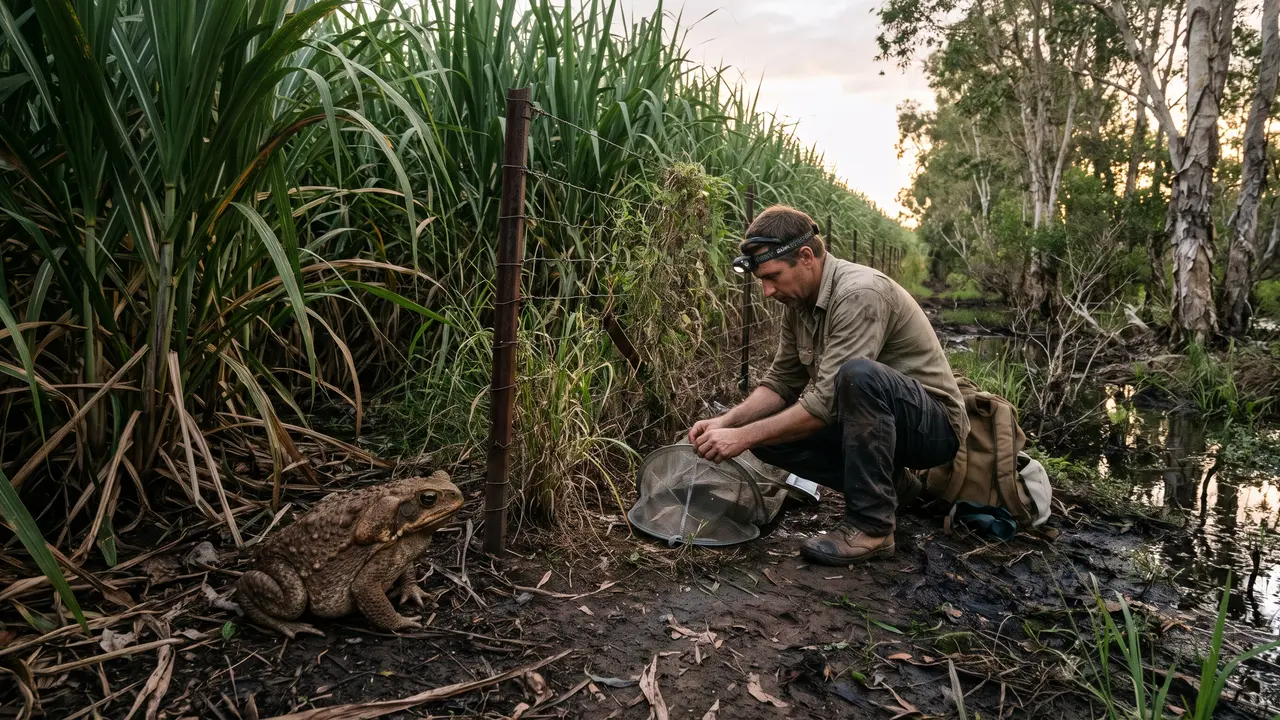
Dal rospo delle canne ai conigli: le trappole del biocontrollo
Dal codice forestale coloniale alla valle di Zinder
La fenologia inversa della Faidherbia albida
Bilancio verso il 2030: i numeri reali tra cantieri FAO, semi di Kew e fondi promessi
- Baobab (Adansonia digitata) e tamarindo (Tamarindus indica): alberi da frutto ad alto apporto alimentare, con la polpa di baobab ricca di vitamina C.[21]
- Acacia del Senegal (Senegalia senegal): specie arborea che fissa l'azoto e secerne la gomma arabica destinata all'esportazione commerciale.[21]
- Dattero del deserto (Balanites aegyptiaca), Carapa procera e Lannea microcarpa: piante da cui i villaggi estraggono oli alimentari, saponi e preparati medicinali tradizionali.[21]
Domande frequenti
Come funziona la Grande Muraglia Verde del Sahel dal punto di vista idrologico e ingegneristico?
Perché oltre l'80% degli alberi piantati nei primi programmi nel Sahel è morto?
Qual è la differenza tra i bacini a mezza luna (demi-lunes) e le buche zaï?
Quanto terreno riesce a scavare l'aratro Delfino utilizzato dalla FAO?
Come funziona la rigenerazione naturale FMNR della foresta sotterranea in Niger?
A che punto è la Grande Muraglia Verde rispetto al traguardo del 2030?
Fonti
30 riferimenti Mostra Nascondi
- UNCCD — The Great Green Wall Implementation Status and Way Ahead to 2030 (si apre in una nuova scheda)
«The GGW is an African-led initiative, launched by the African Union in 2007 and designed to transform the lives of 100 million people by growing an 8,000 km long and 15 km wide mosaic of trees, grasslands, vegetation and plants»
- Smithsonian Magazine — Chris Reij (WRI) sulla mortalità degli alberi piantati (si apre in una nuova scheda)
«Essentially 80 percent or more of planted trees have died.»
- FAO Action Against Desertification — Aratro Delfino e capacità idrica delle mezze lune (si apre in una nuova scheda)
«Mechanized land preparation is carried out using a Delfino plough with a capacity of over 15 hectares per day. This machine creates half-moons which facilitate rainwater infiltration and can store up to 1,000 liters of water in the soil.»
- Right Livelihood — Tony Rinaudo e i 200 milioni di alberi rigenerati in Niger (si apre in una nuova scheda)
«In Niger, 5 million hectares of land with over 200 million trees have been restored this way, with 2.5 million people benefiting from the improved use of the land.»
- UNCCD — Great Green Wall Executive Summary (isoiete 100-400 mm e fabbisogno al 2030) (si apre in una nuova scheda)
«In accordance with the Convention establishing the GGW Pan-African Agency as the coordinating body of the initiative, the intervention zone dedicated to the Great Green Wall is located between the isohyetes 100-400 mm and spans a length of at least 7000 km between Dakar and Djibouti.»
- UNCCD — Lancio del Great Green Wall Accelerator (One Planet Summit 2021) (si apre in una nuova scheda)
«On 11 January 2021, during the One Planet Summit, President Emmanuel Macron of France and other world leaders announced the launch of the Great Green Wall Accelerator and pledged USD 14.3 billion in new funding.»
- Mongabay — Matt Turner (UW-Madison) e stato dei finanziamenti al 2023 (si apre in una nuova scheda)
«“A wall connotes a contiguous band of trees, growing at a regional scale, and nature doesn’t work that way,” says Matt Turner from the University of Wisconsin–Madison, who has studied the Sahelian ecosystems since 1987.»
- Right Livelihood — Mortalità delle piantine nei primi vivai in Niger (si apre in una nuova scheda)
«Scarcely 10 per cent of seedlings survived the heat and dust storms, and the surviving ones would be eaten by goats or cut down by people for firewood.»
- Right Livelihood — Costo per ettaro e diffusione della FMNR (si apre in una nuova scheda)
«Because of its simplicity, local adaptability, low cost (about 20 US dollars per hectare), easy combination with other agricultural methods and quick results, the method spread through peer-to-peer learning among farmers, with limited need for outside intervention.»
- Smithsonian Magazine — Leggi forestali coloniali e rigenerazione a Zinder (si apre in una nuova scheda)
«that countries adopted after independence, any trees on a farmer's property belonged to the government. Farmers who cut down a tree for fuel would be threatened with jail.»
- Smithsonian Magazine — Fenologia inversa di Faidherbia albida (si apre in una nuova scheda)
«When the rains begin, the trees defoliate, dropping leaves that fertilize the soil. Because they have dropped their leaves, the trees do not shade crops during the growing season.»
- Frontiers in Water — Crosta pedologica (soil crusting) e deflusso superficiale (si apre in una nuova scheda)
«Soil crusting reduces the rate at which rainfall can enter the soil, particularly after surface degradation or vegetation loss. Where crusts form, rainfall is more likely to pond briefly and then run off, especially during intense storms (Pasiecznik and Reij, 2020; Roose et al., 1999).»
- Frontiers in Water — Rese di sorgo nelle mezze lune concimate in Burkina Faso (si apre in una nuova scheda)
«Half-moon trials in Burkina Faso further show that water capture alone is insufficient on nutrient-poor crusted soils: compost or manure produced sorghum yields of 900–1,600 kg/ha, 20–39 times the yield of unamended half-moons (Zougmoré et al., 2003).»
- Frontiers in Water — Densità arborea intermedia e ricarica della falda (si apre in una nuova scheda)
«Yet greater tree cover also increases transpiration, and the recharge benefit may decline where tree density or species water use becomes too high. Evidence that intermediate tree cover can maximize recharge illustrates why both tree absence and excessive density can be unfavourable (Ilstedt et al., 2016).»
- Wikipedia — Zaï holes, Yacouba Sawadogo e bioturbazione da termiti (si apre in una nuova scheda)
«Zaï holes were reintroduced since the 1980s by Yacouba Sawadogo, a farmer from Burkina Faso, who introduced the innovation of filling them with manure and compost to provide plant nutrients. The manure attracts termites, whose tunnels help further break up the soil. He also slightly increased the size of the holes over the traditional models. Zaï holes help by improving the yields of trees, sorghum, and millet by up to 500 percent.[3]»
- Wikipedia — Semicircular bund (geometria e dimensioni delle mezze lune) (si apre in una nuova scheda)
«Semi-circular bunds are pits dug in a semi-circular shape, with the excavated material (earth and stone) accumulated along the edges. They usually have a diameter of 2-8 meters (up to 12 meters) and are 30-50 cm high.»
- Wikipedia — Impatto delle mezze lune su miglio e paglia a Téra e Tahoua (si apre in una nuova scheda)
«Impacts of the intervention include increased crop production (millet yields increased by 180 kg and straw yields by 400 kg per hectare per year), increased fodder production, and increased wood production.»
- FAO Action Against Desertification — Efficienza 10x dell'aratro Delfino (si apre in una nuova scheda)
«The Delfino plough not only allows a 10-fold more efficient and affordable means at scale for rainwater harvesting compared to manual work, but it also allows to dig much deeper into the soil for better moisture retention, improving management of degraded lands and grain yields.»
- FAO Action Against Desertification — Bilancio 160.000 ettari e 110 specie native (si apre in una nuova scheda)
«160 000 ha of land under restoration 100 000 households reached 15 million seedlings produced and planted 150 000 kg of forest seeds collected and sown in the field 110 native species prioritized and used for restoration»
- FAO Action Against Desertification — Degrado annuo e siti ripristinati in Niger (si apre in una nuova scheda)
«In Niger, farmers and herders lose almost 100,000 hectares of land every year to degradation.»
- Mongabay — Progetto Royal Botanic Gardens di Kew su 55 specie native (si apre in una nuova scheda)
«The team identified 55 woody and herbaceous species that fit the bill, including baobab (Adansonia digitata) whose fruits are rich in vitamin C; the oil-producing balanite (Balanites aegyptiaca) and African crabwood (Carapa procera); gum acacia (Senegalia senegal) that produces the commercially valuable gum arabic; tamarind (Tamarindus indica), used as food; and African grape (Lannea microcarpa), used as medicine.»
- Mirko Kulig — Sistema Vallerani e specifiche dell'aratro Delfino³ (si apre in una nuova scheda)
«The new Delfino³ plow has a single reversible plowshare which through a wave motion digs crescents or micro basins 5 meters long, 50 cm deep and spaced about 2 m. Even with very low rainfall (1500-500mm/year) each micro-basin can collect over 1000 litres of water, including runoff.»
- UNCCD — Fondi erogati al 27 marzo 2023 (si apre in una nuova scheda)
«Thus far, US$ 2.5 billion of the funding pledged at the One Planet Summit has been disbursed, with the remaining US$17.5 billion expected by the end of 2025.»
- UNCCD — Riesame quinquennale dell'Accelerator 2026, panorama degli impegni (si apre in una nuova scheda)
«Tracking the $19.6 billion pledge landscape»
- UNCCD — Riesame quinquennale dell'Accelerator 2026, ettari ripristinati al 2025 (si apre in una nuova scheda)
«Target 2030 vs Achievement as of 2025 HECTARES UNDER RESTORATION Target 100 million ha Achieved 1.66 million ha»
- UNCCD — Riesame quinquennale dell'Accelerator 2026, dagli impegni alle erogazioni (si apre in una nuova scheda)
«The next frontier is translating these commitments into timely disbursements.»
- UNCCD — Great Green Wall Executive Summary, ritmo e costo al 2030 (si apre in una nuova scheda)
«To reach a total area of 100 Mha by 2030, it is necessary to raise the current pace of land restoration to 8.2 Mha annually. This is estimated to cost between USD 3.6 billion and USD 4.3 billion per year, reaching a total of between USD 36 billion and USD 43 billion up to 2030.»
- UNCCD — Riesame quinquennale dell'Accelerator 2026, progetti conteggiati (si apre in una nuova scheda)
«Out of the 389 projects reported in the GGW Observatory as of 31 December 2025, the following figures are compiled from fewer than 90 projects»
- FAO Action Against Desertification — Ettari ripristinati e gestiti in Niger (si apre in una nuova scheda)
«In total, FAO has helped to restore and manage over 20,000 hectares spread over 55 sites in the Tillabéri and Tahoua and Dosso regions.»
- Frontiers in Water — Runoff nei campi senza cordoni di pietre in Burkina Faso (si apre in una nuova scheda)
«In Burkina Faso, plots without stone lines lost 31% of rainfall as runoff»