Dal rospo delle canne ai conigli: le trappole del biocontrollo
Perché 102 rospi delle canne nel 1935 e 24 conigli nel 1859 hanno scatenato disastri ecologici in Australia: errori di calcolo, tossine e virus coevoluti.
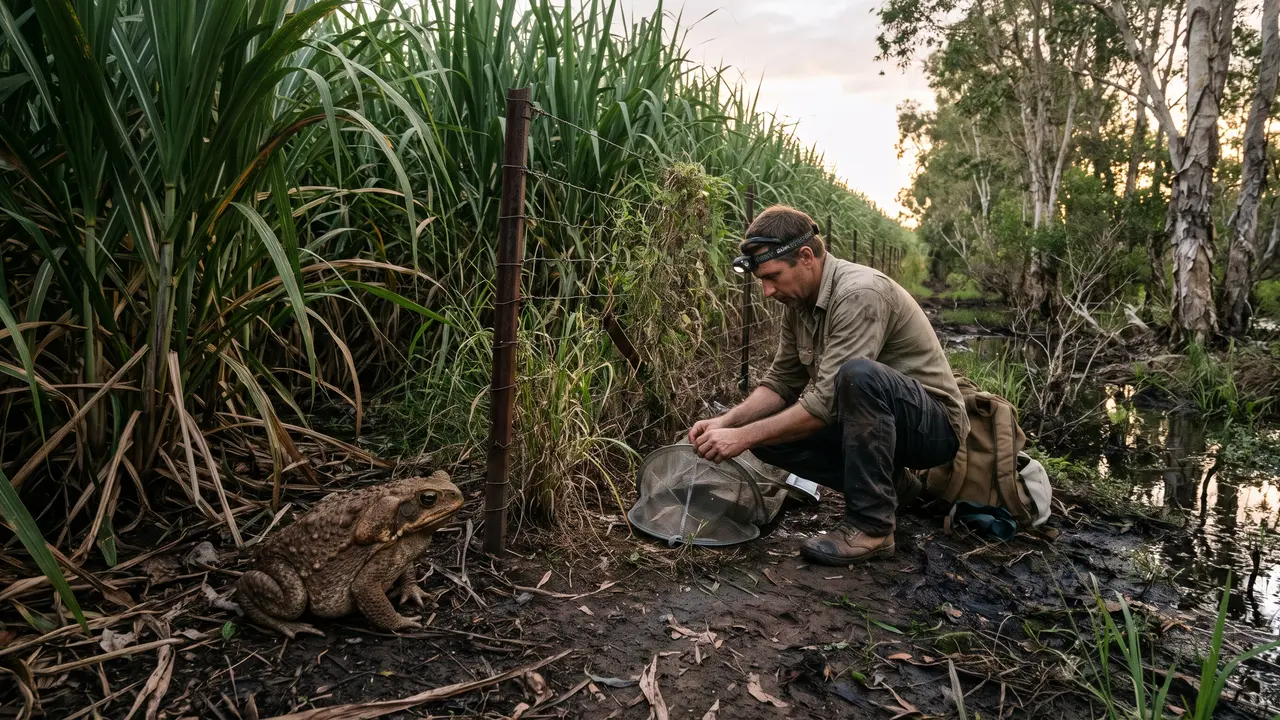
Nel giugno 1935 furono importati dalle Hawaii 102 rospi delle canne; nel 2011 se ne stimavano oltre 200 milioni.
- Nucleo importato nel 1935
- 102 rospi
- Esemplari portati a Gordonvale dalle Hawaii, oggi oltre 200 milioni[1][5]
- Covata di una femmina
- 30.000 uova
- Fino a 15 volte le 1.000–2.000 uova annue delle rane native australiane[6]
In questo articolo
Salta a una sezione
L'errore geometrico del 1935: un predatore di terra contro un insetto d'alta quota
Cascata trofica e risposta evolutiva: cosa succede a un continente senza bufonidi
- Quoll settentrionale (Dasyurus hallucatus): presso la stazione di monitoraggio di Mary River, nel Kakadu National Park, la popolazione seguita via radio nel 2002 è crollata tra ottobre e dicembre subito dopo l'arrivo dei rospi, risultando localmente estinta entro marzo 2003 con zero catture nei campionamenti di maggio e luglio.[8]
- Rettili predatori e varani: in tutta l'Australia 75 specie di rettili risultano potenzialmente minacciate dall'ingestione letale del rospo, inclusi entrambi i coccodrilli, tutte le 14 specie di tartarughe d'acqua dolce, 37 specie di agamidi su 63 e 22 specie di varani su 26.[8]
- Nidi a terra di uccelli: nel Queensland sud-orientale la predazione da parte dei rospi ha causato il fallimento del 33% dei nidi del gruccione iridato (Merops ornatus).[9]
75 specie
I 24 conigli di Thomas Austin e il segreto genomico del Natale 1859
| Parametro d'invasione | Rospo delle canne (1935) | Coniglio europeo (1859) |
|---|---|---|
| Nucleo fondatore | 102 adulti importati dalle Hawaii (62.000 giovani rilasciati entro il 1937)[1] | 24 esemplari con ascendenza selvatica sbarcati a Melbourne per Barwon Park[10] |
| Velocità di avanzamento | 40–60 km all'anno attraverso il nord australiano[6] | 100 km all'anno, record per un mammifero introdotto[11] |
| Popolazione di picco stimata | Oltre 200 milioni di individui entro il 2011[5] | Circa 600 milioni di individui alla fine degli anni Quaranta[12] |
La trappola della mixomatosi: quando il virus uccide troppo in fretta
Da leggere · Terra e Geoingegneria
Grande Muraglia Verde nel Sahel: perché gli alberi non bastano
Come si progetta oggi il controllo biologico: quarantena ISPM 3 e metodo centrifugo
Il divieto assoluto sui predatori generalisti
Domande frequenti
Quali disastri hanno causato in Australia le specie aliene introdotte dall'uomo?
Perché il rospo delle canne non ha eliminato i coleotteri della canna da zucchero?
Perché i predatori australiani muoiono quando mangiano il rospo delle canne?
Come si sono adattati i serpenti australiani all'arrivo dei rospi velenosi?
Perché proprio i 24 conigli di Thomas Austin del 1859 hanno invaso l'Australia?
Perché il virus della mixomatosi non ha sterminato definitivamente tutti i conigli?
Quali protocolli impediscono oggi nuovi errori nella lotta biologica?
Fonti
24 riferimenti Mostra Nascondi
- Wikipedia — Cane toads in Australia (importazione 1935 e rilasci 1937) (si apre in una nuova scheda)
«In June 1935, 102 cane toads were imported to Gordonvale from Hawaii, with one dying in transit due to dehydration. By March 1937, some 62,000 toadlets were bred in captivity and then released in areas around Cairns, Gordonvale, and Innisfail in northern Queensland.»
- National Museum of Australia — Introduction of cane toads (agosto 1935) (si apre in una nuova scheda)
«By August 1935, the toads had successfully reproduced in captivity and 2,400 were released in the Gordonvale area. Remarkably, no studies of the potential impact on the environment had been carried out. Nor had the Bureau of Sugar Experiment Stations even determined whether the toad would actually eat the cane beetles.»
- National Museum of Australia — Avvertimento di Walter Froggatt (si apre in una nuova scheda)
«Walter Froggatt, a prominent entomologist, was rightly concerned that the toads would become a significant pest. He successfully prevailed on the federal Health Department to ban further releases of the toad.»
- Wikipedia — Cane toad (fallimento contro Dermolepida albohirtum) (si apre in una nuova scheda)
«However, the toad was generally unsuccessful in reducing the targeted grey-backed cane beetles (Dermolepida albohirtum), in part because the cane fields provided insufficient shelter for the predators during the day,[92] and in part because the beetles live at the tops of sugar cane—and cane toads are not good climbers.[87]»
- Wikipedia — Cane toads in Australia (oltre 200 milioni nel 2011) (si apre in una nuova scheda)
«By 2011 they were estimated to number over 200 million[8] and have been known to spread diseases, thereby affecting local biodiversity.[9] Not only has the introduction of the toads caused significant environmental detriment, but there is no evidence that they have affected the number of cane beetles which they were introduced to prey upon.»
- DCCEEW Australia — Factsheet Cane Toad (fecondità e velocità di espansione) (si apre in una nuova scheda)
«Females can lay 8000–30 000 eggs at a time. In comparison, most Australian native frogs typically lay 1000–2000 eggs per year.»
- DCCEEW Australia — Factsheet Cane Toad (tossicità in tutti gli stadi) (si apre in una nuova scheda)
«The cane toad defends itself through poison and is poisonous, to varying degrees, during all its life stages. Adult cane toads produce toxin from glands over their upper surface, but especially from bulging glands on their shoulders — these exude venom when the toad is provoked.»
- DCCEEW Australia — The biological effects of cane toads (quoll e 75 specie di rettili) (si apre in una nuova scheda)
«The study concluded that 75 species are potentially at risk from the invasion of the Cane Toad. These represent both species of crocodile, all 14 species of tortoise, 37 of 63 species of agamid and 22 of 26 species of varanid.»
- Business Queensland — Cane toad (impatto sui nidi di Merops ornatus) (si apre in una nuova scheda)
«Research in South East Queensland on rainbow bee-eater birds found that cane toad predation caused 33% of nests to fail.»
- PNAS / PMC — Genomic and historical data on Thomas Austin's 1859 rabbits (si apre in una nuova scheda)
«On Christmas Day of that same year, the consignment arrived in Melbourne with 24 rabbits on board (25, 26). These rabbits were taken to the property of Thomas Austin in Barwon Park, near Geelong in Victoria.»
- PNAS / PMC — Velocità di colonizzazione dei conigli (100 km/anno) (si apre in una nuova scheda)
«At a rate of 100 km per year, it took rabbits 50 y to cover an area 13 times the size of their native range in the Iberian Peninsula, making this the fastest colonization rate for an introduced mammal ever recorded (21).»
- National Museum of Australia — Rabbits introduced (picco di 600 milioni) (si apre in una nuova scheda)
«By the late 1940s the rabbit population had rapidly increased to 600 million. This was due to a number of high rainfall years with subsequent good harvests, as well as the Second World War, which had reduced manpower for trapping and fence maintenance.»
- CSIROpedia — Myxomatosis to control rabbits (recupero di 68 milioni di dollari) (si apre in una nuova scheda)
«Within two years of the virus’s release in 1950 Australia’s wool and meat production recovered from the rabbit onslaught to the tune of $68 million.»
- CSIROpedia — Auto-inoculazione di Fenner, Burnet e Clunies Ross (si apre in una nuova scheda)
«In a remarkable demonstration designed to quell public anxiety, Professor Frank Fenner (Australian National University) and two other top Australian scientists, Dr Macfarlane Burnet (the Director of the Walter and Eliza Hall Institute for Medical Research in Melbourne) and CSIRO’s Chairman Dr Ian Clunies Ross, injected themselves with doses of myxoma virus.»
- PMC — Myxoma virus evolution in Australia (letalità iniziale del 99,8%) (si apre in una nuova scheda)
«The virus had been maintained by periodic passage in laboratory rabbits for over 40 years; case fatality rates (CFR) for laboratory and wild rabbits were estimated to be as high as 99.8% [8,127].»
- PMC — Selezione dei mutanti moderatamente attenuati di Myxoma virus (si apre in una nuova scheda)
«Slightly attenuated mutants of the progenitor virus were more readily transmitted by the mosquito vector because the infected rabbit survived longer, while highly attenuated viruses could be controlled by the rabbit immune response. As a consequence, moderately attenuated viruses came to dominate.»
- PNAS / PMC — Adaptive morphological change in Australian snakes (Pseudechis e Dendrelaphis) (si apre in una nuova scheda)
«As predicted, two toad-vulnerable species (Pseudechis porphyriacus and Dendrelaphis punctulatus) showed a steady reduction in gape size and a steady increase in body length with time since exposure to toads.»
- Proceedings B / PMC — Rapid evolution of cane toad toxin resistance in snakes (si apre in una nuova scheda)
«Snakes from toad-exposed localities showed increased resistance to toad toxin and a decreased preference for toads as prey. Separate laboratory experiments suggest that these changes are not attributable to learning (we were unable to teach naive snakes to avoid toxic prey) or to acquired resistance (repeated sub-lethal doses did not enhance resistance).»
- FAO / IPPC — Standard internazionale ISPM 3 sugli organismi per la lotta biologica (si apre in una nuova scheda)
«Questo standard 1 fornisce linee guida per la gestione del rischio relative all'esportazione, spedizione, importazione e rilascio di organismi per la lotta biologica e altri organismi utili.»
- DAFF Australia — Biological control agents (Host specificity testing) (si apre in una nuova scheda)
«Host specificity testing is carried out to ensure that the proposed biological control agent is specific to the target weed or insect pest.»
- DAFF Australia — Revised guidelines for host specificity testing (Metodo di Wapshere) (si apre in una nuova scheda)
«Selection of non-target plant species for testing should be consistent with Wapshere’s (1974) “Centrifugal Phylogenetic Method” and modernisations of this method, including Briese 2003, 2005 and/or Sheppard et al. 2005, or other texts that consider species relationships and potential aspects of selection of non-target test species.»
- PMC — Myxoma virus evolution in Australia (ceppi emergenti con CFR ≥90% e sopravvivenza più lunga) (si apre in una nuova scheda)
«By any conventional measure, these viruses were still highly virulent with CFRs of 90% or more but, on average, infected rabbits survived for longer in an infectious state than rabbits infected with SLS so the emerging field strains were more likely to be transmitted by mosquitoes.»
- PMC — Selezione della resistenza a Lake Urana (CFR dal 90% al 26% in 7 generazioni) (si apre in una nuova scheda)
«Systematic studies using rabbits from a field site at Lake Urana in southern New South Wales demonstrated that over a seven year period, corresponding to seven annual epizootics of myxomatosis and approximately seven generations of selection, CFRs dropped from 90% to 26%.»
- CSIROpedia — Resistenza genetica e risalita a 300 milioni di conigli nel 1995 (si apre in una nuova scheda)
«However, eventually the rabbits became genetically resistant to the myxoma virus as predicted by Ratcliffe and Fenner, and by 1995 had multiplied to an estimated 300 million.»